Everyone loves tasting the local cuisine when they visit somewhere new. Vacation, after all, is the perfect excuse to indulge and sample the variety of food and beverages a region is known for. With its rich soil and moderate climate, Santa Cruz County is an agricultural mecca with fertile fields of strawberries, tomatoes, artichokes, Brussels sprouts, vineyards, and apple orchards. It’s one thing to Yelp your way through each meal and snack break, but to truly savor each bite, you need to know the stories behind the food fueling your weekend adventure.
Liz Birnbaum, one of four authors of Harvesting Our Heritage: Bite Size Stories from Santa Cruz County and founder of The Curated Feast, shared some of her favorite foodie facts that will amplify your Santa Cruz eating experience. We’ve added our own present-day culinary recommendations to create a two-day food tour of Santa Cruz that’s as mouthwatering as it is eye-opening. So, go ahead and eat your way through the weekend while learning about the rich food heritage that’s been shaping our county for generations.
DOWNTOWN’S OFFICIAL DISH
Saturday, Stop 1: Downtown Santa Cruz, Abbott Square What to Order: Potato Balls from Veg on the Edge and the Local Loaf from Cat. Cloud. Companion
As you munch on the fried potato balls at Veg on the Edge, make sure to give thanks to those delectable spuds for their role in establishing Downtown Santa Cruz. “Downtown is here because of potatoes,” says Birnbaum. “How can we be sitting here and not reflect on this alluvial floodplain that provided a really fertile place to grow?” The first Santa Cruz crop commercially grown after the Missions, potatoes were responsible for putting the area on the map as an agricultural hub. Here’s a short summary:
Back in the mid-1800s, when ambitious men were flooding into California to mine for gold, an entrepreneur named Elihu Anthony staked his fortune in farming. He discovered that the site of present-day Downtown Santa Cruz could grow giant five-pound potatoes and he could sell them for an exorbitant price. The rush to profit off potatoes eventually caused the market to crash, but not before convincing many of the miners that the fertile soils of Santa Cruz were a smart place to put down roots.
When you finish your potato balls, get another taste of Santa Cruz next door at Cat. Cloud. Companion. Their hearty Local Loaf is baked with whole wheat from the UC Santa Cruz Farm where they grow six-grain varieties, including quinoa. Pie Ranch, 10 miles north of Davenport, also grows its own grains and even has its own flour mill. They sell bags of their whole-wheat flour at their farm stand along with pies from Companion Bakeshop. The pies all feature locally grown whole wheat crust and rhubarb, strawberries, squash, chard, and eggs from Pie Ranch.
MOO COW ICE CREAM
Saturday, Stop 2: The Penny Ice Creamery What to Order: Any flavor with locally farmed ingredients
From 1860 to 1960 there were about 100 dairies in the Santa Cruz region, known not for their cheese, but for their butters and creams. Brown Ranch, located on five acres where people now shop for the latest styles at the Capitola Mall, was one of the most successful. The ranch’s ‘Moo Cow Ice Cream’ was served in the dining cars of the Southern Pacific Railroad and on cruise ships that crossed the globe.
Moo Cow Ice Cream is no longer in business, but Santa Cruz has several other ice creameries to choose from. The Penny Ice Creamery is the only one, however, that makes their cold confection entirely from scratch and serves experimental flavors featuring ingredients from local farms. The menu changes seasonally so there’s always an excuse to go back for more. In the summer, try their Straight Up Strawberry, Rose Petal Nectarine, or Crème Fraiche Rhubarb.
In Birnbaum’s opinion (a Chicago-native), the Apple Annual was Watsonville’s version of the Chicago World’s Fair. From 1910-1913, the Apple Annual was held over four days filled with parades, dances, vaudeville acts, and literally millions of apples. (2,350,000 in 1910 to be exact.) The event also included impressive replicas of local buildings and world-famous structures like the Panama Canal constructed entirely of apples.
As many as 40,000 visitors attended the event over its three-year run. Although we no longer have an Apple Annual, Wilder Ranch holds an annual Heritage Harvest Festival each fall where you can taste dozens of local apple varieties and vote for your favorite.
“I think of that era as the pre-Disneyland era,” says Birnbaum. “They had to figure out what exhibits would draw people in. To have two million apples and these small-world replicas is just incredible to me.”
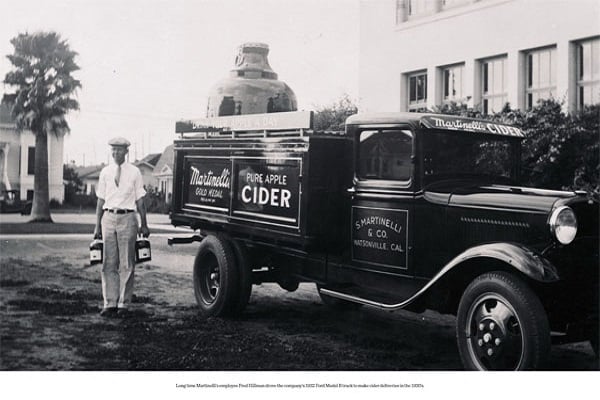
Today, 95 percent of Santa Cruz apples are sold to make juice and the region is known for the sparkling variety, in particular. In 1868, a Swiss man named Stephen Martinelli began his cider-making business. It began as alcoholic cider but when Prohibition took effect, he made the switch to non-alcoholic sparkling cider and never looked back. Martinelli’s is now sold across the world but still only produced right here in Watsonville. Get the full story at Martinelli’s Company Store and try the family-friendly tasting flight while you’re there. (Don’t miss the apple-mango!)
SUN-KISSED STRAWBERRIES
Sunday, Stop 2: Live Earth Farm What to Order: Strawberry U-pick (when in season)
Commercial strawberries didn’t really take off in Santa Cruz until the early 1900s, but by the start of the 21st century, Santa Cruz was known for producing some of the best berries in the world. At the 2008 Olympics in Beijing, China, the athletes demanded three main types of fruit, and one of those was strawberries. Driscoll’s and California Giant leaped at the opportunity to showcase the region’s sweetest crop and shipped Pajaro Valley strawberries across the world to satisfy the Olympians’ cravings.
Today, you can pick your own strawberries at local farms like Live Earth Farm in Watsonville starting mid-May. Bring your own berry basket or bucket (or pay a small fee to use one of the farm’s) and end your foodie tour by strolling through sun-kissed strawberry fields against the peaceful backdrop of the rolling Pajaro Hills.
Want to extend your food tour? Find Harvesting Our Heritage, written by Liz Birnbaum, Jody Biergiel Colclough, Katie Lang Hansen, and Sierra Ryan, at the Museum of Art & History or at Bookshop Santa Cruz. All proceeds from the book go to the Museum.
Birnbaum is also planning more memorable dining experiences through The Curated Feast. Feast attendees can expect a flavorful journey set in a unique Santa Cruz location. Each dish is accompanied by spellbinding storytelling from Birnbaum of the food’s histories and mythologies.
Tammy Le is a warrior. After a major 2008 car accident left her paralyzed, she experienced many mental, physical, and emotional challenges. She has emerged as a strong woman who exudes confidence, and she finds gratitude in the little things that many people take for granted. Everyone can learn from this brave quadriplegic.
BACKGROUND
Le was born in Oakland, and as a child, she moved to both Utah and Texas for short stints. She returned to California as a fourth-grader and lived in Milpitas until the age of 19. After that, she moved to San Jose and has been there ever since.
THE DAY HER LIFE CHANGED FOREVER
In April 2008, Le — a high school senior at the time — was traveling to Santa Cruz from Milpitas via Highway 17. It was towards the end of the school year; all the seniors were headed to the beach. Le was a passenger in the back seat of a friend’s car. Another car on the highway was speeding and cut their car off; her friend swerved to avoid being hit and then hit the median, and the car flipped. The impact was heavily on Le’s side, and she was caught under the car. The resulting spinal cord injuries left her paralyzed from the chest down.
SANTA CRUZ IN THE PAST
Prior to her injury, Le’s fondest memories of visiting Santa Cruz were going to the beach and the Santa Cruz Beach Boardwalk. “I loved the hustle and bustle of the Boardwalk. My favorite thing to get was a caramel candy apple.” Le regrets that she didn’t take the time to experience the rides; now she wishes she had.
SANTA CRUZ IN THE PRESENT
After the accident, Le did not visit Santa Cruz for several years. The first time she came back was in early 2022. As the car reached the Santa Cruz exit, she experienced very strong emotions. “I bawled because I felt like this is what should have happened (on April 14, 2008). The next couple times, it’s been better. I have come to enjoy food, to observe the beach, and to enjoy the scenery.” She likes comfort food a lot. “At the Santa Cruz Wharf, you can get a variety of things like clam chowder or a taco or pasta. I love that you can get all these things in one place.”
A HEALING JOURNEY
Le’s third journey to Santa Cruz after the accident was for a special purpose. She had been invited to participate in a “Visit Santa Cruz County/Let’s Cruz” commercial. “When I went to film the commercial, it was incredibly healing because I felt I was in a much different place in my life. The folks from VSCC were very accommodating and understanding towards the symptoms I experience due to paralysis. Not being able to walk affects my ability to regulate my nervous system and body temperature. The crew brought a generator, heater, and all forms of warming material to ensure that I was comfortable. Not many people are that understanding and patient.”
There were multiple reasons why this experience was healing. “First, life came full circle. I had been petrified of revisiting Santa Cruz—especially scared about being on the road where my life changed drastically. Now, every time I am on that road, it helps me face my fear. Every time I make it here safely, it feels good because of every ounce of power over that fear that I can take.”
FINDING COMFORT IN NATURE
Another reason the commercial experience was beneficial, Le says, is because she always finds nature to be healing. “It was great to be on that Redwood Trail (in Henry Cowell Redwoods State Park) for the commercial. The world is not made to be accessible for disabled people, so anytime I can be somewhere like that (in nature, which is more accessible) is wonderful.”
She notes that, for many disabled people out there interested in traveling to Santa Cruz, the town has “lots of great nature spots to explore, plus trails, beaches, etc. Henry Cowell is one of these places.” There are also beach wheelchairs at many Santa Cruz County state beach locations (reserve one here) but she has not personally tried these. She has heard of adaptive kayaking and is interested in trying it sometime. Shared Adventures is one organization that helps disabled individuals explore sports like kayaking and canoeing.
PRIDE AND INCLUSION
Fourteen years ago, after the accident, Le didn’t think of herself as attractive or worthy. “Being cast in a commercial reminds me how far I’ve come, reminds me of all the work I’ve put into myself. I’m also proud to be representing the disabled community, as there can be a lack of diversity when it comes to inclusion.”
RECEIVING STRENGTH FROM FAMILY & COMMUNITY
Le is very thankful for her family. “They are the #1 reason that I stay positive, the support has been unreal. They’re the reason I’ve gotten to where I am today. Not just immediate, but cousins, and more. I can count on them to come through, whether it’s to provide last-minute caregiving support or anything else!” She also receives lots of support from people in the spinal cord injury and physical therapy communities. “The PT community is very tight-knit.” She refers to PT with Mike Terrell and Kayla at a Neuro Fitness Gym called SCI-FIT as “amazing…also Adaptive Pilates at Zebrafish Neuro with Stephanie Comella. They’re like friends and family.”
BECOMING AN OBSERVER
The way Le sees the world has, of course, significantly changed now that she is a quadriplegic. “The main shift in my perspective is that due to my disability I’ve gotten used to becoming more of an observer because the world isn’t as accessible.” She wishes she had taken the time, before her injury, to appreciate things like walking along the beach and dipping her toes in the ocean. “Now, if I dip my toes in the ocean, I can’t feel it. But I still hold deep gratitude for being able to enjoy life and all these things as an observer.”
CREATING POSITIVITY DURING PANDEMIC
During the pandemic, to stay positive she exercised frequently and created a bunch of social media content (cooking, makeup tutorials, etc.) that she posted on her Instagram account @resilient.comm. She also walked her dog Mello a lot. “The power of having a companion pet is astounding. I rescued him a little before the pandemic started. He had zero forms of training, yet somehow adapted to my disability. I just hook him into the metal bar that’s attached to my wheelchair, and he follows my lead as I wheel.” During the pandemic, she also found a multitude of ways to do wheelchair and bed workouts which helped tremendously with her mental health. “As much as I miss going for a run, I feel the same level of endorphins when I push myself around our kitchen island in my manual chair to strengthen my arms. I appreciate finding any opportunity and outlet to get my body moving.”
CREATIVELY RAISING FUNDS
In 2013, Le started an online apparel business to raise money for physical therapy and other medical expenses not covered by insurance. You can visit the Resilient shop at resilientquad.bigcartel.com and also see some of the products on her Instagram.
REMAINING CHALLENGES
When asked what businesses could do to better serve disabled travelers Le replied, “In a word: Accessibility. I wish there was more inclusion, like ramps and paved floors. Ramps—in restaurants and other places—would really enhance our quality of life and inclusion within society. There are so many places with stairs. We’re forced to do vigorous research and calling before going somewhere to ensure that there are no steps, in order for us to have access to a location. There should be more accessible parking, too. Table heights that work better with wheelchairs. I have to make tons of calls and do research before I travel somewhere. Otherwise, if I show up, and it doesn’t work, I feel embarrassed as everyone is staring at me. Another source of inclusion can be more heat lamps: not being able to walk, my body runs cold. People don’t think about the fact it’s more than not just being able to walk, there are other symptoms.”
A REQUEST TO DRIVERS
Le implores people out there to drive carefully, and at a speed, they’re comfortable with, especially on dangerous roads like Highway 17. “Also, make sure to watch for people that tailgate or cut you off, there are lots of drivers like this.”
FINAL THOUGHTS
“I’ve learned that you don’t need to be able to walk or have legs to have a fulfilling life. I am capable, and I have the ability to advocate for myself. Advocating for yourself doesn’t require legs. It takes more work, but it’s possible.” It took many years, but Le now recognizes and embraces her resiliency. “Through all my trials and tribulations my takeaway is how much power I possess to direct my own life.”
If you have yet to attend a First Friday, Santa Cruz County’s massive monthly art party, you may be wondering what all the fuss is about. Yet once you go, you’ll understand why the popular event draws a lively, fun-loving crowd. Below, we’ve broken down First Friday basics – what it is and what to expect – so you can mark your calendar and join the fun!
WHAT TO EXPECT
On the first Friday evening of every month, Santa Cruz galleries, shops, and cultural venues open their doors to showcase the works of Santa Cruz County artists. With a block party-like vibe, the multi-venue event provides an opportunity to discover local creative talent in a fun and festive setting. The great food and drink help too. Many venues entice attendees with yummy cheese-and-wine-filled spreads, while others have food trucks joining in on the fun.
“First Friday is so much more than paintings on walls, it’s an interactive, engaging experience,” says Bree Karpavage, Director First Friday Santa Cruz. “First Friday gives the community an opportunity to explore our creative culture and experience the vibrant and thriving energy of the Santa Cruz art scene.”
Photo 1 and 2 courtesy of the Arts Council Santa Cruz County
But as you will soon see, there are many more places to explore. Find additional participating venues and artist information on the First Friday website and follow them on social for sneak peeks, artist features, and more.
WHERE SHOULD I START?
The best advice is to start where you are. If you’re on the Westside, start at the R.Blitzer Gallery. If you’re near Downtown Santa Cruz, start at one of the Downtown anchor venues like the MAH, Curated Gallery, or RREVV Gallery and work your way to the Tannery. On the Eastside, start at the Treehouse Dispensary which hosts 3 artists and a makers’ pop-up, plus live music each month. For Midtown, stop in the Santa Cruz Art League. And if you’re in the San Lorenzo Valley area, Santa Cruz Mountain Art Center is a great hub for First Friday!
With that all being said, the Tannery Arts Center in Santa Cruz is worth making your starting point (regardless of where you are) if you aren’t quite sure where to begin. On First Friday, they have a dozen or more artist’s studios open, unique exhibits, live music, free and easy parking, plus food trucks on site to fuel your evening of exploration. Speaking of those unique and unusual exhibits, in April of 2022, the Tannery featured the lighted kinetic dragonfly sculpture by Burning Man artist Brian Argabrite. They have more public art installations in the works for future events, so stay tuned.
Radius Gallery, Printmakers at the Tannery, and Indexical – a site for radical and experimental work – are highly recommended for First Friday Tannery must-visits.
IT’S MORE THAN JUST GALLERIES
In addition to rubbing elbows with local artists and fellow art lovers, you’ll also discover new (and new-to-you) shops and galleries. Artisans & agency has long been an enthusiastic supporter of local artists. They were one of the first venues to feature prominent local artists like September Wren and the late Doug Ross. On First Friday, Artisans & agency hosts additional Santa Cruz artists such as Diana Hartman, who has the motto, “Paint on Everything – I haven’t met a thing that can’t be painted on;” Annika James, a painter with a fondness for landscapes; Peter Koronakos, an assemblage artist who uses found objects to create animal sculptures; and Erika Perloff, a plein air painter native to the Bay Area.
It’s not just artisan shops that are participating. On First Friday, boutiques, wineries, and cultural venues are transformed into temporary galleries. Botanic and Luxe finds space between its curated collection of earthy and luxurious goods for featured artists and a specialty cocktail bar for their First Friday experience. Stylish boutique, Stripe, also hosts a lively artist reception for First Friday.
Santa Cruz Museum of Natural History on East Cliff Drive, waves admission to the museum on First Fridays; features artists; and hosts special outdoor festivities, including a Makers Market, food, and drinks.
Photo courtesy of Abbott Square Market
Looking for those block party vibes during your First Friday expeditions? Abbott Square Market hosts energetic weekend concerts, and on First Friday, the square gives a celebratory atmosphere with live music, libations, and great eats in their outdoor space at the MAH. It is the perfect place to end the night dancing with locals and celebrating the amazing Santa Cruz County arts and community.
“First Friday is such a fun way to explore Santa Cruz County’s vibrant arts community,” says Jim Brown, Executive Director of Arts Council Santa Cruz County. “With more artists per capita than almost all US cities, there is always something new to discover. Whether it’s an evening out with family, meeting up with friends, or a shopping excursion for art that will brighten your home, Frist Friday is one of the best ways in Santa Cruz to start your weekend.”
Have you spotted any of the ocean and environmental-themed public art that is now on display in Santa Cruz? Nineteen (and counting) ocean advocacy murals entitled Sea Walls: Artists for Oceans is the first of its kind in Santa Cruz and is made possible by the PangeaSeed Foundation – an organization who works to create meaningful environmental change for oceans through science, education, and ARTivism (SEA). The Sea Walls Santa Cruz Mural Map shows where the new murals are located and who the artist(s) are who created them – many of which are Santa Cruz County locals. Several other artists joined in on the project including folks from Oakland, San Francisco, Emeryville, Los Angeles, Portland, Reno, Hilo, Hawaii, Greensboro, South Carolina, and Vienna, Austria.
The project was directed by local muralist and activist Taylor Reinhold over the course of three years; he secured mural locations, recruited artists, and oversaw the production of the project from start to finish. In alignment with the sustainable mission of the project, environmentally-friendly non-toxic paint that absorbs carbon was used for the murals.
Take a look below for some of the amazing, beautiful, inspiring, and important murals created with the Sea Walls: Artists for Oceans project. Enjoy, and be sure to visit the murals in-person on your next tour around town.
Lauren YS (Los Angeles, CA) 2391 Mission St, Santa Cruz, CA 95060 – Dominos / Wall Facing Mission West Parking Lot
Mural Theme: Endangered kelp forests Artist Statement: “This mural addresses the declining health of the kelp forests off the coast of Northern California through anthropomorphization of the invasive purple sea urchin, the leopard shark, and the sunflower starfish, ecological signposts of the imbalanced ecosystem threatened by CO2 pollution and rising ocean temperatures. Drawing inspiration from the 80’s rich punk, skater, and surfer subcultures of Santa Cruz, this super-saturated trio of characters suggest the underlying struggle to counteract the adverse effects of global warming on the local kelp forests and welcomes the viewer to take part by consuming more invasive sea urchins, recycling, reducing their CO2 footprints and becoming further educated on the health of the local seascape.” – Lauren YS
Griffin One (Oakland, CA) 2335 Mission St, Santa Cruz, CA 95060 – Mission Liquors / Visible from You Do It Car Wash Mural Theme: Micro-plastics in the marine food chain Artist Statement: “Plastic pollution is overtaking and clogging up our ocean’s waters – and killing our ocean creatures all the way up the food chain. I designed and painted this piece to help create awareness about this issue. Many creatures in our oceans are eating and ingesting MicroPlastics, and sadly absorbing their chemicals, because these tiny, hazardous pieces of plastic are often mistaken for food, and are not digestible. This cycle eventually and inevitably circles back onto the land (from which it came), and also deeply affects creatures above sea level that rely on the Ocean as a source of food. These creatures include the Native Sea Birds, such as the Brown Pelican… as well as us humans. All of us creatures are neck-deep in this together!” – Griffin One
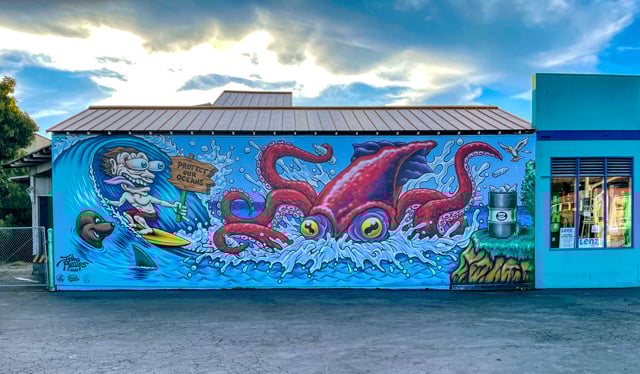
Jimbo Phillips (Santa Cruz, CA) 142 River St, Santa Cruz, CA 95060 – Lenz Arts / Wall Facing Parking Lot
Mural Theme: Plastic pollution Artist Statement: “The theme of my mural was plastic pollution, which is a huge concern to me, so I tried to convey the message in a fun colorful way, so people will enjoy the image and then absorb the message. The giant Squid is ridding the sea of plastic, and the surfer and seal are stoked and are supporting him because the ocean is important to everyone!” – Jimbo Phillips
Made Fresh Crew – Scotty Greathouse, Tyler Filkins, Evan Cusack, Erika Rosendale, Kyle Sanders, Joe Fenton, Casey Landaker, Joe Fitz, Maia Negre (Santa Cruz, CA) 204 Church St, Santa Cruz, CA 95060 – Birichino Winery
Mural Theme: Ocean stewardship, climate change, pollution, overfishing Artist Statement: “This group mural by the Made Fresh Crew Ground Ops Team came together at the end of the week after being inspired and driven by the amazing artists of Sea Walls Santa Cruz, PangeaSeed Foundation, and the community that came together to support this massive creative production. Collaboration is vital, and we must come together with our fellow creatures on this planet to foster sustainability if we are to survive. The darker, far side of the mural shows remnants of human waste, including stylized ropes, oil spills, and gassy gunk that has bleached the coral on one of the underwater reefs. As the mural continues, a story of hope is ignited as more life, animals, and movement swirl around an illuminated circle of marine beasts in a healthy ocean. We wish to inspire others to bring many hands together as we did, to continue telling this story of hope so that it can be the reality. Reading from left to right, instead of projecting the doom from the irresponsible habits we currently uphold as a society, we chose to change the narrative to manifest a brighter future.” – Made Fresh Crew
Jet Martinez (Oakland, CA) 601 Front St, Santa Cruz, CA 95060 – Front St Parking Garage / Botanic & Luxe Corner
Mural Theme: Plastic pollution impact on local marine mammals Artist Statement: “The theme of my mural is plastic pollution and its effect on sea creatures… in this case the iconic California sea lion. The idea with this piece was to create a design that was simple and elegant but that also told a story. In some of my work, I use patterns to illustrate the idea that everything in nature is connected. The large overall background blue water pattern is mimicked within the sea lions and kelp forms. The viewer should see a simple and playful composition of sea lions doing their graceful thing in the water. But as one steps closer or looks longer, other shapes start to appear: specifically garbage. Masks, water bottles, plastic bags, etc. I wanted to allude to the idea that as there is more and more trash all around, we are becoming desensitized to it, and it somewhat fades into the background. However, trash is so prevalent in our oceans, that it seems an inaccurate depiction to paint natural scenes and not include it. I want to challenge the viewer to see the garbage we are putting into the world, and to recognize that it is creating a tremendous disharmony in the natural order of things.” – Jet Martinez
JEKS ONE (Greensboro, NC) 601 Front St, Santa Cruz, CA 95060 – Frazier Lewis Lane / Soquel / Front St Parking Garage
Mural Theme: Overfishing & rising sea levels Artist Statement: “The figure represents the capitalist top 1% dining on the very last of the coho salmon due to decades of overfishing and choosing profits for now instead of sustainability for the future, neck-deep in rising seas due to the climate change that he chooses to deny and ignore. This is sadly the way we are headed without real change.” – JEKS ONE
Kai Kalukukui (Hilo, HI) 601 Front St, Santa Cruz, CA 95060 – Frazier Lewis Lane / Soquel / Front St Parking Garage
Mural Theme: Endangered kelp forests and Invasive species Artist Statement: “Help Da Kelp” is a representation of invasive purple sea urchins, eating a kelp forest to devastation. Seen on the bottom are abalone and a sea star, who are affected by the habitat loss caused by the urchins, as well as a few sea otters who are in the background probing for lunch. The kelp on the top can be viewed as the last stragglers, transforming into bubbles towards the right, as a nod to the amount of oxygen that will not be produced from these dying algae. The ramifications of global kelp deforestation are heavy, as the ocean is responsible for every other breath you take.” – Kai Kaulukukui
Ricky Watts (Oakland, CA) 601 Front St, Santa Cruz, CA 95060 – Frazier Lewis Lane / Soquel / Front St Parking Garage
Mural Theme: Rising sea levels and global warming Artist Statement: “It’s not a secret. Evidence of global warming is all around us. Living near the ocean, I see first hand the erosion of our bluffs, trash on our shores and frequent coastal flooding during high tide. It pains me to witness the careless neglect many have for our most precious resources. I created this work to help bring awareness and change to our way of life, because our current path is unsustainable. Our ocean levels are rising and sooner than later, our shores will begin to look very different. Let’s give future generations an even better, healthier planet so they can enjoy the same experiences we do.” – Ricky Watts
Abi Mustapha (Santa Cruz, CA) 435 Front St, Santa Cruz, CA 95060 – Sesame Korean Grill / Wall facing Cathcart St
Mural Theme: Coastal development and climate change Artist Statement: “My goal for this mural was to bring back a sense of connection between what we do on land and how it affects the ocean which in turn sustains our whole world. By making the whale the center of the piece with an oil refinery on its back I hope to convey the serious weight and stress that our land usage has on other beings we share this planet with. Even ones we don’t always feel the direct connection with. I wanted the reds of sunset and blues of the ocean to bring in our connection with land and sea in a vibrant eye-catching way that would make people passing look twice at what’s actually going on in the image. I want people to see beauty and feel a sense of responsibility.” – Abi Mustapha
David Rice (Portland, OR) METRO Bus parking Lot – Crazy Crab at 429 Front St.
Mural Theme: Shark Conservation Artist Statement: “For my mural I teamed up with Save Our Seas Foundation to bring awareness about the plight of sharks around the world. On average sharks are responsible for less than 10 human deaths a year, whereas humans kill over 100 million sharks every year. Sharks have been given an unwarranted stigma in our society as monsters that are out to get us, when in fact they are just like any other animal on our planet. My goal for this mural was to take the shark out of a dark, ominous marine setting and place it in surroundings that are more familiar to us such as the iconic California poppy flower. Removing the boundaries that separate us, I hope to show that we are all part of a larger ecosystem. Our success as a species depends on the well being of our oceans and healthy oceans need healthy shark populations.” – David Rice
Nychos (Vienna, Austria) 1010 Pacific Ave, Santa Cruz, CA – METRO Bus parking Lot – Pacific Apartments at 1010 Pacific Ave.
Mural Theme: Ocean Stewardship Nychos’ mural is a memento for women to embrace their change-making power as well as drive home how crucial it is to better protect and preserve the world’s marine environments. The customarily lighthearted, cheerful mermaid Ariel is filled with anger at the state of the world’s oceans. With issues ranging from coastal development, overfishing, pollution, and climate change, it is time that humanity wakes up to the reality of these challenges and stops pretending that everything will be okay. As a representation of Mother Ocean, she calls on us to become better stewards of the sea and fight for our planet’s life-support system.
Alexandra Underwood, Joey Rose (Emeryville, CA) 37 Municipal Wharf, Santa Cruz, CA 95060 – Santa Cruz Wharf near Gildas
Mural Theme: Endangered kelp forest Artist Statement: “Unfortunately, the effects of climate change can be seen here in the kelp forests off the coasts of Northern California. After disease took out a large population of the kelp forest’s natural defenders, the sunflower sea star, thousands of purple urchins have taken over. Fortunately, the small but mighty sea otters are fighting on the front lines of this issue! Protecting and providing healthy habits for all ocean critters has an immense effect throughout the ocean ecosystem.” – Alexandra Underwood & Joey Rose
Shane Jessup (Los Angeles, CA) 619 Soquel Ave, Santa Cruz, CA 95062 – York Framing / Wall Facing Soquel Ave.
Mural Theme: Human impact on the ocean environment (pollution, sea level rise, overfishing, and biodiversity loss) Artist Statement: “Ocean pollution, the rise of sea levels, overfishing, loss of species – all due to the actions and inactions of humans. The longer humans (represented by Pluto and his bident) continue to ignore these actions, the Ocean (represented by Poseidon and his trident) will continue to push back in an attempt at healing itself. A constant battle until we change our actions and begin to heal and restore instead of destroy and ignore.” – Shane Jessup
“From the Mountains to the Sea, Keep Our Waters Plastic Free”
Madeleine Tonzi (Oakland, CA) 619 Soquel Ave, Santa Cruz, CA 95062 – York Framing / Parking Lot Wall
Mural theme: Plastic pollution and coastal wetlands Artist Statement: “From the Mountains to the Sea, Keep Our Waters Plastic Free,” takes into consideration the impacts of plastic pollution, and highlights the interconnectedness of our waterways and how climate change and human actions are impacting those systems. In this piece, the viewer is led from the tops of the mountains, through the streams and rivers, into the wetlands, and out to the beaches and sea. It is a story of the earth’s symbiotic ecosystems, as well as the path in which plastic debris makes its way into the oceans, ultimately permeating every aspect of marine life. I chose to use bright pops of fluorescent red to symbolize the effects of climate change on the ocean and included mountains to draw the connection between landlocked places, coastal living, and aquatic life. Through my work, I want to convey a sense of beauty and calm, and appreciation for the environment, while also highlighting the challenges the ocean and its inhabitants face as a result of direct human action. It is my hope this will inspire people to consider the interconnectedness of all life on this planet and its fragility, and in turn, take action to remedy the damage we have done.” – Madeleine Tonzi
Caia Koopman (Santa Cruz, CA) 730 Soquel Ave, Santa Cruz, CA 95062 – Santa Cruz Movement / Parking Lot Wall
Mural Theme: Ocean Acidification Artist Statement: “Our oceans are facing so many hardships these days from human-caused climate change, plastic pollution, to massive overfishing, and much more, so it’s always an interesting challenge for me to pick a subject to focus on. My mural is titled “Let’s Solve the Dissolve” and is about ocean acidification and the fact that our oceans have become acidic enough to dissolve shells and kill coral. Our oceans have been absorbing nearly a third of all carbon emissions and 90% of excess atmospheric heat, in a sense saving us from the effects of catastrophic climate change so far, but there’s a limit to what they can do to help. Our excess CO2 + H2O = Carbonic Acid, so unless we want an ocean of acid we need to “Solve the Dissolve” together.” – Caia Koopman
Zoe Boston (Oakland, CA) 1827 Soquel Ave, Santa Cruz, CA 95062 – Community Printers / Back of parking lot visible from Soquel Ave.
Mural Theme: Endangered marine species and biodiversity loss Artist Statement: “Over the last three years, approximately 400 gray whales have died due to various circumstances that include but are not limited to lack of fish, pollution and toxins in the water, and sound waves that disturb the whales. In my piece, a guardian of the ocean breathes life and protection to the gray whales through bubbles, As the ocean also gives life to her, symbolizing our relationship and connection with water. Humans are about 75% water and can’t live without it so, as we take care of our own bodies we should also be taking care of our bodies of water and have respect and care for the creatures that live in it.” – Zoe Boston
Hannah Eddy (Reno, NV) 1827 Soquel Ave, Santa Cruz, CA 95062 – Community Printers / Alleyway Wall
Mural Theme: Ocean stewardship Artist Statement: “Protect What You Love is such a powerful statement that could truly lead to lasting change if we all embraced it. This mural celebrates the importance of finding a connection with nature in order to appreciate and preserve it. When we fall in love with activities (like surfing) that are so directly related to healthy oceans, breathable air, clean water, stable weather patterns, and a healthy snowpack we can’t help but think about what we can do to protect the environment. Through my art, I hope to encourage more people to get outside and experience the natural world in order to nurture our love for it and to help preserve it for future generations to enjoy.” – Hannah Eddy
Max Ehrman (San Francisco, CA) 1501 41st Ave N, Capitola, CA 95010 – Orange Theory
Mural Theme: Marine stewardship Artist Statement: “When you first observe the mural, you’ll notice a strong water line that divides the mural into three parts, night, day, and a fantasy water scene with sea life. This form is anchored and balanced by the moon and cosmos on one side, with the sun on the opposite side. Like all things in nature, there is a balance. The sun and moon represent a balance between night and day, alpha/omega/ yin/yang male/female. These energies control our known environment, and if one is out of balance, the earth will change and suffer. The tidal water line rushes to the top, thus bifurcating the image into two distinct images. This rising waterline represents the rising tidal changes around our coastal cities around the world. I was born and raised in South Florida, and my family comes from Cuba; I’ve watched our coasts erode away due to the rising tides due to climate change and warming. I used to go diving with my parents in Key West every summer, and I have vivid memories of the vibrant corals and aquatic life.” – Max Ehrman
“Ghost in the Forest” Plastic Pollution and Kelp Deforestation by Commercial fishing
Gats 3621 Soquel Dr, Soquel, CA 95073 – Airtight Vinyl Siding & Window side wall facing Treehouse back parking lot
Mural Theme: Plastic pollution and overfishing Artist Statement: “Ghosts in the Forest” is in reference to the massive amount of Ghost Gear abandoned in the ocean and kelp deforestation by commercial fishing. Fishing nets make up about 10% of the overall plastic pollution in the ocean and about 46 percent of the floating plastic in the Great Pacific Garbage Patch. Bottom Trawling devastates ecosystems by scraping the ocean floor with giant nets. Not only do these kill dolphins, sea turtles, protected fish, and many other species but it also has a similar effect on the environment as clear-cutting a forest on land. Estimates suggest that seaweeds take nearly 200 million tons of CO2 out of the atmosphere every year.” – Gats
More About the Project
September 2021, PangeaSeed Foundation’s global Sea Walls: Artists for Oceans program created 19 ocean conservation-themed murals in Santa Cruz. Completed in a week with over 25 artists from a mix of Santa Cruz, California, and across the country. The large-scale artworks speak to locally relevant, pressing marine environmental issues such as plastic pollution, ocean acidification, warming seas, local biodiversity loss, environmental justice, and more. The mission is to empower individuals and communities to create meaningful environmental change for the oceans by raising public awareness of critical environmental issues through SCIENCE, EDUCATION, and ARTIVISM (S.E.A.) The project was produced by the Made Fresh Crew and is supported by the City of Santa Cruz Department of Economic Development, Lost Coast Plant Therapy, and the Save Our Seas Foundation, amongst others. PangeaSeed’s local partner, Made Fresh Crew, is a collective of Santa Cruz artists who collaborate on art projects locally & internationally. From their 500ft long ocean sustainability Mission Street mural to numerous large-scale community projects, Made Fresh Crew drawsinspiration from street art, education, and activism.
Made Fresh Crew (Local Artists and Operations Crew)
Taylor Reinhold Scotty Greathouse Tyler Filkins Evan Cusack Erika Rosendale Kyle Sanders Joe Fenton Casey Landaker Joe Fitz
Sponsors
City of Santa Cruz Department of Economic Development Lost Coast Plant Therapy Save Our Seas Foundation A Tool Shed South Swell Ventures (Bud Colligan) Patagonia Smog Armor Montana Tannery Arts Center Treehouse Aqua Breeze Inn Community Printers Monterey Bay Eco-Tours Liquid Death
It’s not just masked superheroes that dazzle audiences in blockbuster movies. Given its cinematic landscape and iconic attractions such as the Santa Cruz Beach Boardwalk, coastal redwood forests, miles of sunny beaches, and the legendary Highway 1, Santa Cruz has enjoyed many starring roles dating back to the early 20th century. In addition to the surfers at Steamer Lane — and surfing seal — featured in “The Endless Summer,” Santa Cruz has played host to vampires, Dirty Harry, and even maniacal clowns from outer space. Break out the popcorn and roll out the red carpet, Santa Cruz is taking you to the movies.
The Role of the Santa Cruz County Film Commission
The Santa Cruz County Film Commission is a department within Visit Santa Cruz County. It works to promote Santa Cruz County as a film destination. To leverage its resources, the film commission maintains a membership in the Film Liaisons in California, Statewide (FLICS) which is comprised of film commissioners and film liaisons from around California. While all film commissions work a bit differently, the Santa Cruz County Film Commission primarily serves as a resource for production companies coming to town by providing location and permitting information. It also features film-related listings free of charge for local businesses and freelancers within the county to help support the local film industry. The local film commission receives leads and copies of approved permits from the California Film Commission and other jurisdictions from around the county letting them know where productions have been given the green light to film. The California Film Commission works to approve locations such as state parks, state beaches, and state highways. Although the film commission receives a lot of questions from cinephiles asking if any productions are currently being shot in the county, production companies like to keep their intel under wraps so their projects can proceed uninterrupted.
On Location in Santa Cruz County
Santa Cruz County has played starring roles dating back to 1911 when the San Lorenzo Valley served as the dusty, Old West setting for numerous silent, black-and-white westerns featuring actors such as Broncho Billy Anderson and Mary Pickford. You can view a summary of production credits here.
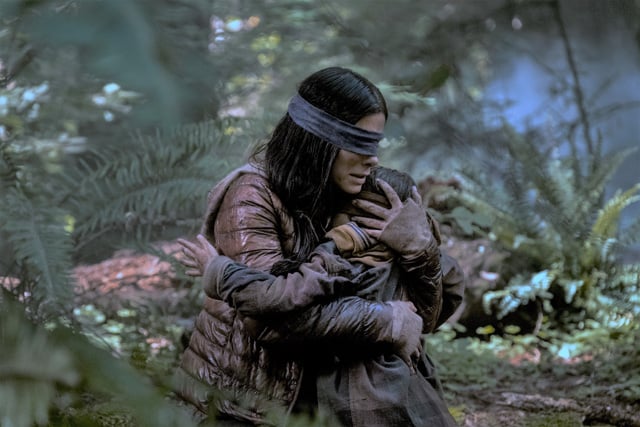
MOVIES Birdbox (2018) The story is set in a post-Apocalyptic world and centers around Malorie Hayes, played by Sandra Bullock, as she tries to protect herself and two children from supernatural entities: if you see them, you die. The small group proceeds on a dangerous journey through the forest and down a river to find a place that may offer safety. During the trip, they’ll have to keep their eyes covered from the evil that chases them — and complete the trip blindfolded. Portions of the film were set at Henry Cowell Redwoods State Park.
Bumblebee (2018) In the spin-off of the popular Transformer series, Santa Cruz plays the fictionalized town of Brighton Falls, the stomping ground of a certain shape-shifting, yellow VW bug. Set in 1987, the film featured local extras clad in 80s attire parading around the municipal wharf and Santa Cruz Beach Boardwalk…rather, the Brighton Falls Boardwalk. The film included scenes shot on the Santa Cruz Wharf and at the Santa Cruz Beach Boardwalk.
Us (2019) Starring Lupita Nyong’o, Winston Duke, and Elizabeth Moss, a family sets out for a relaxing beach vacation to Santa Cruz but is followed by a group of threatening doppelgängers. Filmed at the Santa Cruz Beach Boardwalk, Main Beach, and the Seabright neighborhood in Santa Cruz.
Chasing Mavericks (2012) This endearing film tells the true life story of surfer Jay Moriarity and his quest to conquer the legendary big waves of Mavericks. Unlike most films, Chasing Mavericks was filmed almost exclusively in Santa Cruz, and you can use this map of film locales as a de facto tour of Santa Cruz’s vibrant surf community.
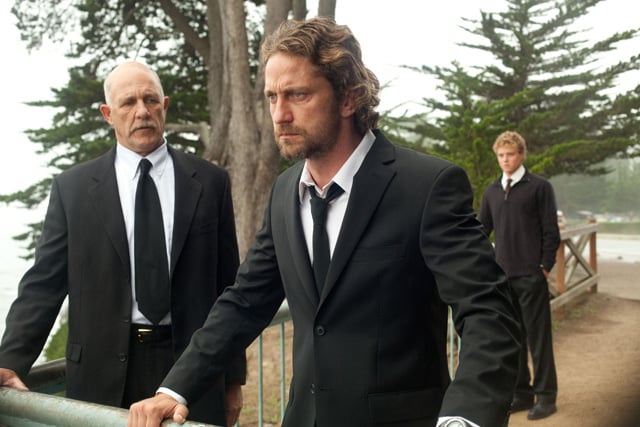
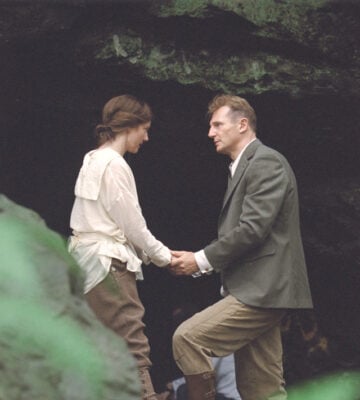
Kinsey (2004) Based on the life of sexologist Alfred Kinsey starring Liam Neeson, Laura Linney, Chris O’Donnell, Peter Sarsgaard, John Lithgow, Oliver Platt, and Timothy Hutton. Scenes were filmed at Big Basin Redwoods State Park.
Frog & Wombat (1998) Gal pals Alli and Jane (codenames: Frog and Wombat) set out on a mission to detect if their new principal is involved in a murder. In the process, they traipse all over Santa Cruz County including Henry Cowell Redwoods State Park, Santa Cruz High School, and Deer Park Shopping Center in Aptos.
Dangerous Minds (1995) Based on a true life story, Michelle Pfeiffer plays a teacher to disenfranchised teens who enjoy a break from a hardscrabble life on a field trip to the Santa Cruz Beach Boardwalk, where the class enjoys a ride on the Giant Dipper Roller Coaster.
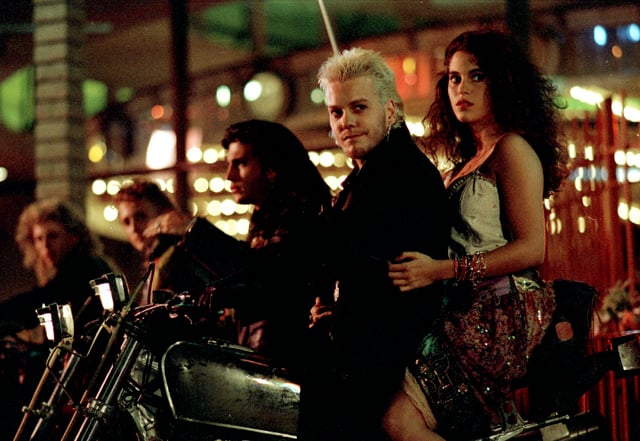
The Lost Boys (1987) Perhaps the most celebrated of locally shot films, this 80s staple pairs the two Coreys—Haim and Feldman—with Kiefer Sutherland in the vampire-filled town of Santa Carla. The local classic usually kicks off the free summer movie series at the Boardwalk, and even inspired a drink menu at Abbott’s Square’s cocktail bar, Front & Cooper. The iconic vamp flick celebrated its 30th anniversary in 2017, and the Santa Cruz County Film Commission honored the occasion with a self-guided film location map.
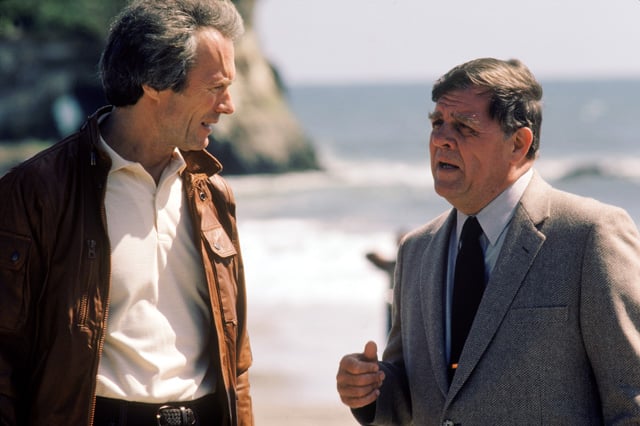
Sudden Impact (1983) This 80s thriller made our day when it filmed in Santa Cruz. “Dirty” Harry Callahan chases criminal in the seaside town of ‘San Paulo’ which shows off West Cliff Drive, Santa Cruz Wharf, the main post office in Downtown Santa Cruz (which doubles as a courthouse) and the Boardwalk. Watch Callahan resolve things with a bang near the historic Giant Dipper in the film’s climactic ending.
Harold & Maude (1971) A cult fave telling a darkly humorous story about an unlikely twosome who play games and whirl round rides at the Boardwalk. The film offers a great peek of the pinball-filled Casino arcade that predates Pac Man and Frogger.
Not every feature filmed in Santa Cruz was an Oscar contender. Here are some fun flicks you may have missed:
Killer Klowns from Outer Space (1988) The name says it all in this delightfully trashy film where monstrous, circus clown aliens wreak havoc on the small town of Crescent Cove (a.k.a. Watsonville) and the Santa Cruz Beach Boardwalk.
Romeo.Juliet (1990) Distinguished film actors such as Ben Kingsley, Vanessa Redgrave, and Maggie Smith lent their voices to this Belgian take on the Shakespeare classic whose characters were played by—wait for it—real, live feral cats.
The Tripper (2006) Big Basin Redwoods State Park served as the setting for David Arquette’s campy horror flick that had modern day hippies being terrorized by a Ronald Reagan-masked killer and featured Courtney Cox and Paul “Pee-wee Herman” Reubens.
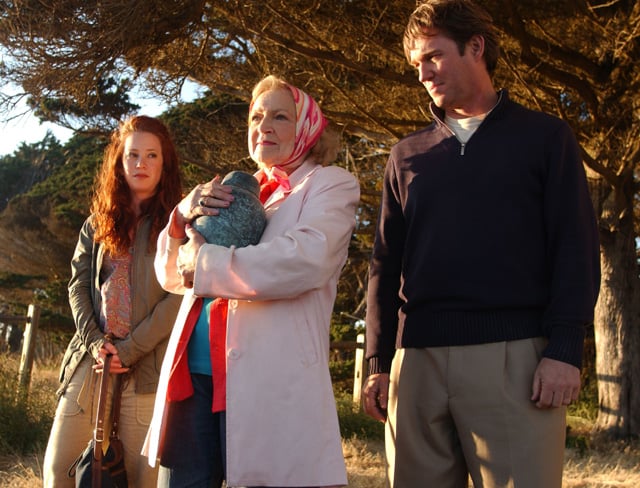
TELEVISION It’s not just the big screen, either. Santa Cruz has appeared in TV movies such as the Hallmark Channel’s 2005 “Annie’s Point” whose drama played out along the north coast town of Davenport and which starred Betty White and Richard Thomas.
Santa Cruz County has also been featured on The Weather Channel, The Oprah Winfrey Show, and a “Video Daily Double” clue on Jeopardy!
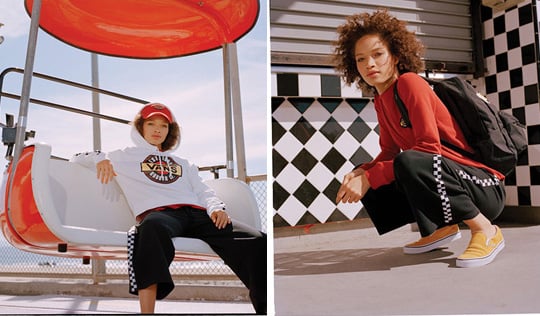
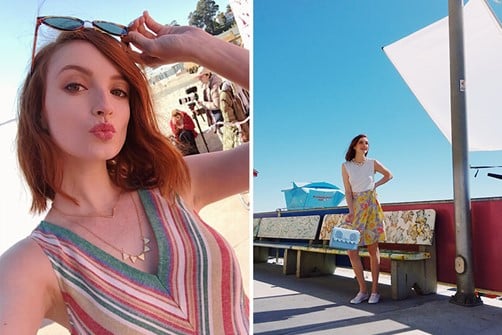
FASHION FORWARD Before we roll the credits, there are other productions which have come to the Santa Cruz area for its scenic backdrop. Still and filmed commercial shoots for cars have been produced on our beaches, Highway 9 in the Santa Cruz Mountains, and in Downtown Santa Cruz. In fact, these types of productions are in essence Santa Cruz County’s “bread and butter” projects when it comes to filming because of the steady requests for scenic locations and the quick turnaround time for productions from start to finish.
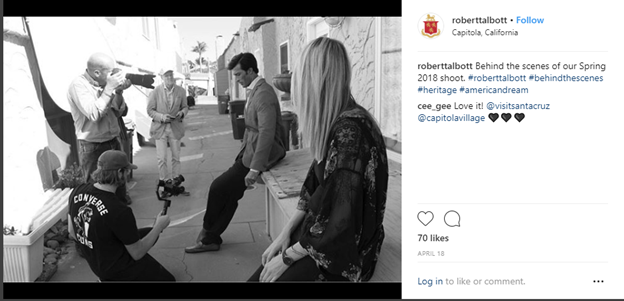
Monterey-based Robert Talbot Clothiers launched their spring 2018 campaign with a shoot in Capitola Village.
The result was this mesmerizing video whose smartly dressed lads stroll Capitola’s easy-on-the-eyes shores. Content was also shared on the bespoke clothing company’s Instagram page.
TAKE IT OUTSIDE No commercial campaign would be complete without the name O’Neill. Late wetsuit pioneer and Santa Cruz local Jack O’Neill called Santa Cruz home and helped bring California’s iconic – and official – sport of surfing to the world stage. What began as an experiment with neoprene all because he wanted to stay in the water longer to surf became Jack O’Neill’s namesake brand, synonymous with surfing, which his creations helped bring to the world stage. Still headquartered in Santa Cruz, O’Neill wetsuits are a mainstay for surfers around the globe and campaigns are shot regularly at local points of interest and surf spots.
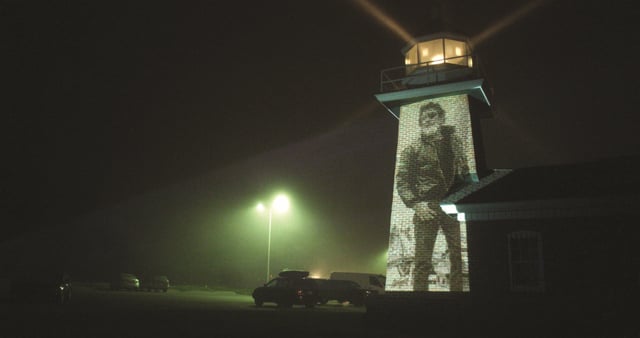
At the beginning of 2020, O’Neill launched its “First Name in the Water” campaign, which combined classic imagery and video from the brand archive projected against world-famous landmarks throughout Santa Cruz County. The Lighthouse at Steamer Lane, Jack O’Neill’s cliffside home on 41st Ave, The Wharf, Natural Bridges and more iconic locations synonymous with the brand were used in the shoot.
“We wanted to mix the brand heritage with contemporary surf and do it in a unique way. We also wanted to wrap the campaign around the town of Santa Cruz, the birthplace of the O’Neill brand. That desire is really where the projector concept came from and the use of the projector literally gave us the ability to blend heritage and modern surf on historically significant landmarks. Locations significant not only to Jack O’Neill and his brand, but also the town of Santa Cruz and in many ways, surf culture as a whole,” said O’Neill Senior Art Director Deke Angel.
In addition to its beaches, Santa Cruz County’s forests have served as a backdrop for commercial shoots. GIRO – headquartered in Scotts Valley – manufactures helmets and goggles for the snow and cycling industry, as well as cycling apparel and shoes, and soft goods for cycling, skiing and snowboarding. GIRO’s recognition of Santa Cruz County as the epicenter of action sports – in particular mountain biking – makes area cycling trails and rider-friendly forests a natural backdrop for their campaign shoots.
THE GOLDEN TICKET A round-up of film projects which featured Santa Cruz County would not be complete without a mention of the work of Visit California. Representing destinations throughout the state as well as attractions, hotels, resorts, state and national parks and beaches, wineries, and restaurants, Visit California regularly films commercials aired nationally and internationally toting The Golden State’s appeal to visitors near and far. Through a strong relationship with the state tourism board and because Santa Cruz County represents a “beyond the gateway” destination – generally meaning counties which are not major urban centers and which do not have major airports within their boundaries – Visit California often includes the area in promotional campaigns. An abundance of scenic points of interest, natural beauty, and coastal and redwoods locations also add to the appeal as a filming location for the state.
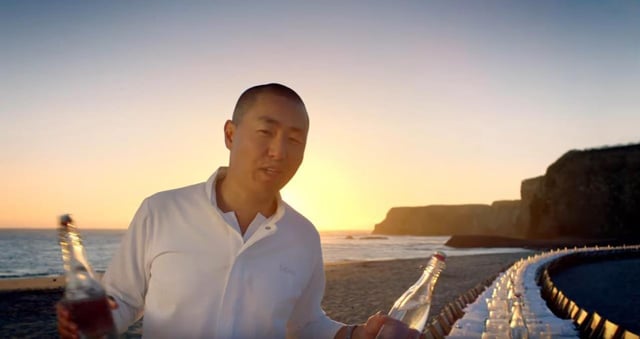
Santa Cruz County has been featured in three campaigns launched by the state tourism agency including Dream Big’s Dreamers – filmed at the Santa Cruz Harbor, Kidifornia’sKids at Play – filmed at Henry Cowell Redwoods State Park, and Dream Big’s continuation Living the Dream– filmed at Davenport Beach and Henry Cowell Redwoods State Park. Living the Dream was a 15-day comprehensive shoot alone spanning nine regions throughout the state including 17 cities and 24 different locations. The concept of the “Dream Big” campaign was to show a variety of settings throughout California, with catchy dialogue extolling the laid-back attitude of the Golden State. An elegant table, illustrating a field-to-table dinner set for 200 guests made up the setting at Davenport Beach, where filming took place at sunset. San Francisco Chef Corey Lee, owner and chef of the 3-Michelin-star-ratedBenu and In Situ restaurant inside the San Francisco Museum of Modern Art hailed by the New York Times as “America’s most original new restaurant”) officiates over the setting and delivers the line “Same old, same old.” with a shrug of his shoulders as a golden California sunset sinks into the sparkling blue Pacific Ocean.
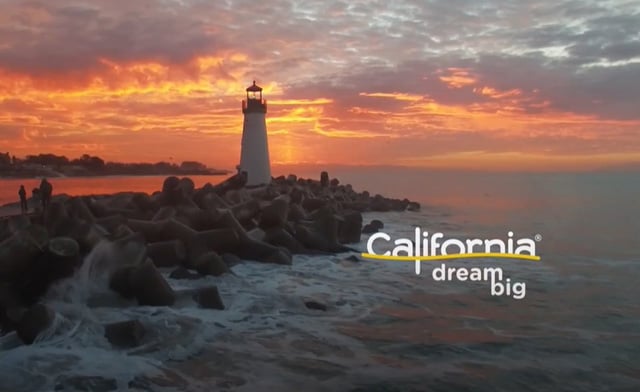
More recently, Visit California launched Dream With Us in an effort to encourage visitors to plan-now-travel-later and to provide much-needed inspiration as travelers worldwide were sheltering-in-place in spring of 2020 when the global COVID-19 Pandemic hit. The spot ended at the Santa Cruz Harbor’s Walton Lighthouse with a peaceful sunset shot.
That’s a Wrap!
So the next time you’re streaming your favorite flick, see if you can guess filming locations which set the scene for the story: they may be closer than you think! Film locations are often identified during the end credits with a shout out to the state or local film commission which helped support the production, which in turn brings a valuable economic boost to that area in the form of overnight accommodations for crew and talent, as well as support services like caterers, equipment rentals for local businesses, and hiring extras for background scenes (not to mention bragging rights for cinephiles everywhere!)
With its deep-rooted art scene, Santa Cruz is highlighted in geometric patterns and splashes of color in the form of vibrant murals. Mural spotting in Santa Cruz can be an all day adventure or simply an opportunity to grab a few minutes of color pop bliss between destinations. From historic downtown Santa Cruz, to the quieter South County, feast your eyes on these artistic masterpieces that highlight this diverse area.
SANTA CRUZ
Learning from the Past, Living in the Present, Looking Toward the Future Composed of seven individual panels, the mural in the Beach Flats neighborhood of Santa Cruz paints a vibrant picture the city’s past and acknowledgement of its future. An interpretive sign in English and Spanish explains the significance of each picture. Got kids? Two uncrowded playgrounds adjacent to the mural are the perfect location to visit before or after a trip to the nearby Santa Cruz Beach Boardwalk.
Community Quiltage In need of a face lift, the Santa Cruz Museum of Art and History located in Downtown Santa Cruz was awarded a grant for artist Thomas Campbell to transform a blank wall into a decorative wall of art. Campbell’s work is that of quilt pieces which stitch together multiple pieces of the community through history and art. Follow it around the side of the building at ground level, or step into Abbott Square for a larger view.
Black Lives Matter In conjunction with artist and activist Abi Mustapha, Santa Cruz became the first city in the U.S. to work with city government to paint a BLM mural. Completed by community volunteers, this permanent work is located on Center Street in front of City Hall in Downtown Santa Cruz.
Words of Wisdom “Wildflowers don’t care where they grow.” Sage advice from singer/songwriter, Dolly Parton. The owner of Typsy Gypsy boutique located in Midtown, and the owner of the shop next door wanted to share this sentiment with the world. They collaborated with McKella Jo to permanently plant the words on their building. Shop and see the flowers.
Bay in a Bottle In this unique painting, the artist used a painting technique known as “trompe l’oeil” in this three-dimensional creation which stretches along the side of local grocery store, Shoppers Corner. Bay in a Bottle feels like you can step into the cool blue ocean encapsulated in a bottle.
PLEASURE POINT
Whale + Waves Located on East Cliff Drive, Santa Cruz artist Jeremiah Kille utilizes bright colors and geometric patterns to tie together themes of nature and coexistence. A turquoise whale connects to waves of the same hue which surfers catch nearby. This mural was created in honor of his friend Tusher Arte. Want to see more of Kille’s work? Check out his equally bright patterned mural on the back wall of Beer Thirty in Soquel.
SEACLIFF
The Sea Meets the Park Want a place for the kids to let off energy, and engage with art at the same time? The Seacliff Village Park Mural checks both boxes. In fact, artist Anastasiya Bachmanova felt the vibrant colors would inspire artistic creativity for younger audiences while serving as a catalyst for teaching about local conservation. If you want to see the cement ship and look for sharks in person Seacliff State Beach is only a short drive down the road.
Moveable Murals In the interest of creativity, the city of Watsonvilleengaged in a public arts project called Movable Murals. Each piece was created by a different artist and placed outside of city hall. Murals focus on topics such as the regions’ history, landscape, and people. Each year the pieces are moved to different locations to offer a fresh perspective. For more information, check the Pajaro Valley Arts website.
Watsonville Metro “United by Pride, Dignity, and Knowledge” at the Watsonville Metro will remain in place as people come and go. The mural updated this year tells the story of culture and tradition in the community. It was completed as a a collaborative project by artist Guillermo (Yermo) Aranda and local youth.
Sabor In Spanish “Sabor” means flavor. With its bright, strategically placed colors, this 62-foot-long mural pays homage to the artist’s roots and the community where it is located.
First Christian Church Ome Garcia’s work uses bold color to create works which tell a story and provides intentionality. His recent project, Watsonville History Mural at First Christian Church, is no different. Rising up the bell tower are snapshots of the area’s history from the Strawberry owners who arrived in the early 20th century to the more current struggle for civil rights.
THE VALLEY
Remembering Sky Park Airport Located on the back of the Scotts Valley Library, the Sky Park mural pays tribute to the Scotts Valley airport which operated from 1947 to 1983. Organized by Dawn Teall, the mural was completed by community members who volunteered to grab a brush and paint outlined sections on the wall.
James Dean Alongside the iconic Brookdale Lodge leans an imposing figure, non-other than James Dean. The twenty-foot-tall mural was created by John Cerney. Each of his pieces are characterized by large cut out panels which use the surrounding area as the background. James Dean supposedly visited the lodge in its prime along with other Hollywood A-listers.
MORE NOT TO MISS MURALS
Clean Oceans Mural It is hard to miss this 500 foot long mural dedicated to bringing awareness to marine pollution. Spanning what seems like the entire length of Mission Street, wide eyed sea otters tangle in beds of kelp can be seen as humans dive for plastic. If you want to dive into this color explosion, it is best seen on foot. Street parking can be found around the corner on Bay St.
On the River The San Lorenzo River Walk spans Santa Cruz by following the curve of the river. In preparation for the Ebb and Flow River Festival, artist Sarah Bianco has begun work on a mural at the Tannery Arts Center depicting creatures of the San Lorenzo River. Located behind the main buildings, this work is an ever-expanding piece, so be sure to check it out again the next time you visit to see what magnificent beings are emerging from the paint.
While Watsonville has become a recent hub for independent artisans, a pioneer of its burgeoning craft scene is Annie Morhauser who founded her Annieglass glassware studio amidst the town’s sprawling agriculture fields in 1983. Today, her luminous pieces are featured at high profile hotels and retailers-Four Seasons, Neiman Marcus, the Bellagio in Las Vegas-and two of her pieces are on permanent display at the Smithsonian. Yet, each elegant piece continues to be handmade here in Santa Cruz County. Here are three reasons to visit Annieglass this season:
#1: Marvel at artful glassware handcrafted in Santa Cruz County
Annieglass’ lustrous glass tableware are functional pieces of art. Offered in a range of styles-from classic to contemporary-Morhauser is constantly expanding her offerings with new pieces each year. Since her start, she’s been lured to produce her pieces offshore, yet Annieglass remains proudly in Watsonville. The company’s pieces are distributed throughout the U.S., Europe, and Asia, yet, you’ll find the largest selection at retail shop located at the Watsonville HQ. Seasoned shoppers take note: the retail shop also features a great selection of seconds that are available at a considerable discount.
#2: Annieglass Makes for a Great Gift
Annieglass is always an extra special gift, but did you know you can also add a personalized engraved message? For $25, Annieglass will engrave the back of the piece with up to 60 characters using a handheld etching tool. And those etchings are done by the skilled hands of Annieglass employees – some of which have been doing these gorgeous engravings for decades!
#3: Supporting Sustainability
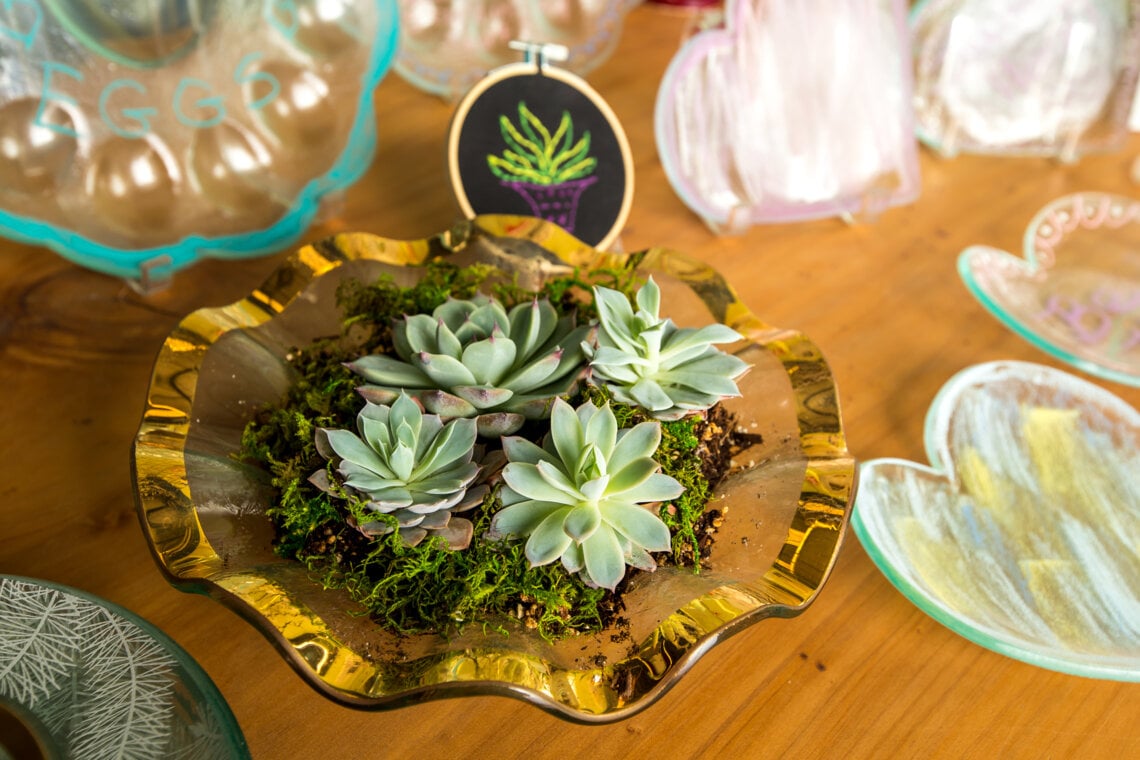
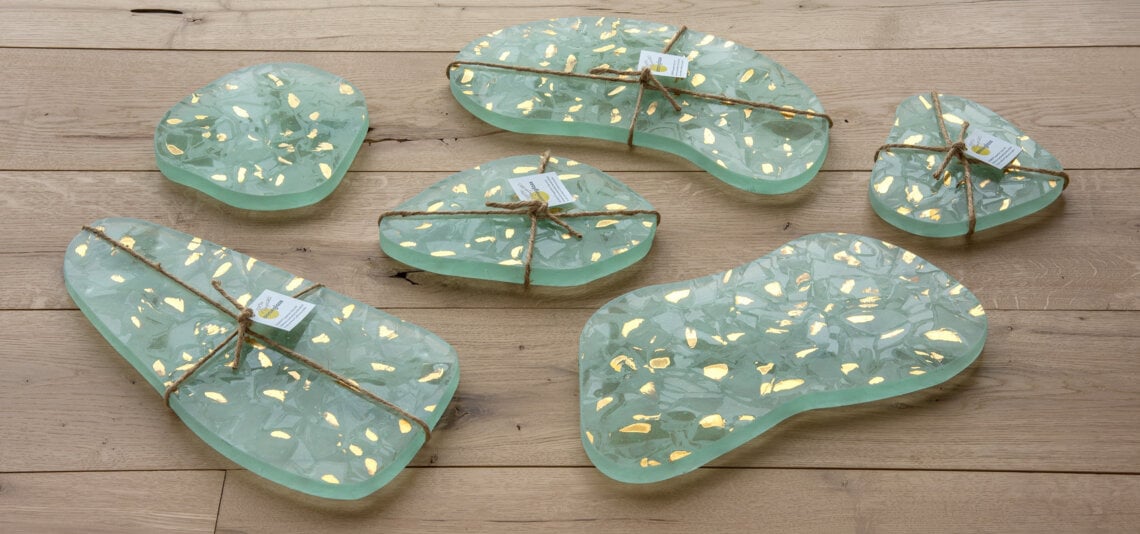
When purchasing Annieglass, you can also have piece of mind that you are buying products that are sustainably made. Endlessly inspired by nature, Annie Morhauser became dedicated to environmental responsibility long before “green” became a trend. Eco-sourcing, recycling, reusing and zero-waste goals have been standards for this atelier-turned-production-studio since opening in 1983. The glassware pictured above is from the Elements collection which is created with scrap glass that has been remelted. The watery green color and ghostlike effect of the many melted pieces of glass fusing together has made this collection a favorite. By reusing scrap glass, the studio is able to maintain near zero waste goals by avoiding using landfills and consciously utilizes green practices in every step of production.
The link between Santa Cruz and Hawaii extends beyond their share of sunny beaches and laid-back vibes. In 1885, three, vacationing Hawaiian princes dazzled Santa Cruz locals by riding waves on makeshift boards they had made from redwood planks. It marked the introduction of surfing to the mainland U.S., and sparked a nationwide craze that began here in Santa Cruz. Today, the region brims with other Hawaiian imports such as poke bowls and Kona coffee that will transport you to the islands. From ono grinds to ukulele melodies, here’s where to find aloha in Santa Cruz County.
Go back to where it all began at the Santa Cruz Surfing Museum which showcases Santa Cruz surfing from the day the three Hawaiian princes took to their redwood boards. Housed in an iconic, memorial lighthouse overlooking famed surf break Steamer Lane, the cozy museum is crammed with fun surfing memorabilia including vintage wooden surfboards. Outfront, look for a brick memorial that commemorates the genesis of mainland surfing—a gift from the descendants of Prince Kawananakoa—and the link between Santa Cruz and Hawaii.
With vintage surf decor, glowing puffer fish
lamps, and a velvet painting of Elvis, this kitschy-cool restaurant is a fun,
retro tribute to the 50th state. The lengthy menu features a crowd-pleasing mix
of Hawaiian-inspired dishes such as crispy shrimp rolls, mango BBQ ribs, and
fresh fish in a variety of preparations. Against a backdrop of exotic tiki mugs
and a TV screening surf flicks, a lively bar shakes up classic tropical drinks
including Mai Tais, Zombies, and Blue Hawaiians. Don’t miss the daily happy
hour—4-6 p.m., and all night on Tuesday—when pupus and cocktails are $6!
Pono Hawaiian Grill
One step into this colorful, downtown Santa Cruz
eatery, and you’re transported to a beachside eatery in Waikiki. The airy
dining room captures all the elements of your favorite, casual Hawaiian
joint—island decor, relaxed vibes, and tables topped with bottles of shoyu and
sriracha—but the real aloha comes from the kitchen. Homesick Hawaiians will
find comfort in classic dishes such as musubi, pork lau lau, ahi poke, and teri
chicken. Plus, it wouldn’t be a proper plate lunch without your choice of
Hawaiian Sun drink. For something more potent, the Reef Bar is stocked with
rum, and as well as Hawaiian and local brews. Grab a Mai Tai, and head to the
sunny patio with outdoor seating set amidst the leafy palm trees,
High Tide Poke Shop
Build your dream poke bowl at this downtown
Santa Cruz stop which shares a storefront with HōM Korean Kitchen. The
customizable menu offers your choice of base, protein, and sauces to suit your
cravings, whether you’re feeling Ahi tuna with spicy mayo or miso crab over
noodles. Plus, a seemingly endless list of toppings such as avocado, edamame,
and mango adds to your vibrant creation. Enjoy it on the patio overlooking the
bustling scene on Pacific Avenue.
MJA Vineyards
Before he began making wine, Marin John
Artukovich was a coffee farmer on the Big Island, and his love of the islands
is readily apparent at his Westside tasting room. Displayed alongside MJA’s
cabernet sauvignons, bags of Artukovich’s 100% Kona coffee tempt visitors with
their rich aroma. You’ll also find bags of other island goodies such as
chocolate-covered macadamia nuts and espresso beans, the latter of which is
paired with cabs during tastings. Swing by Tuesdays, Friday, or Saturday, and
you can pair other wines such as the Wipeout sauv blanc with savory dishes from
a rotating line-up of chefs and food trucks.
Ukuleles at Harbor Beach
The Santa Cruz Harbor offers visitors many attractions, but perhaps the most surprising is regular concerts from hundreds of crooning ukulele players. For the past 17 years, the Santa Cruz Ukulele Club has assembled enthusiasts of the mini, four-string Hawaiian guitar with regular gatherings around town. The most popular is likely the Saturday morning gathering at Harbor Beach, behind The Crow’s Nest from 10 a.m. – 12 p.m. Stop by and enjoy the aloha shirt-wearing orchestra of strumming players who belt out familiar songs such as California Dreaming and Margaritaville. On the second Wednesday of every month, Pono Hawaiian Grill also hosts a Ukulele Party with various artists lending a sweet soundtrack to the dining room.
Aloha Outrigger Races + Polynesian Festival
Each August, the City of Santa Cruz celebrates its Hawaiian ties with a Polynesian Festival held on the Municipal Wharf with plenty of Polynesian music, dancing, and shave ice to fuel a luau. The signature event is an outrigger race, and the public is encouraged to participate. Novices take note: the local Pu Pu O’Hawaii Outrigger Canoe Club will provide your group with the two key team members, the stroker and steerer. Don your best aloha wear, and you can take home the Outrigger Aloha Spirit Award!
Relics of the Spanish and Mexican eras, the county’s oldest buildings have fascinating stories to tell.
Driving through busy modern-day Santa Cruz County, it’s hard to imagine a time when the rolling hills ran down to the sea uninterrupted by houses, bridges, roads and office buildings. But of course that’s what the first Spanish settlers found when they marched up from Monterey to establish a mission in 1791. To build the Misión de la Exaltacion de la Santa Cruz, they used the materials at hand—timber, felled at great effort and expense, and dirt, plentiful and free.
Given the two choices, it’s easy to see how adobe, a mixture of earth and water bound by straw or manure, became the predominant building material not just in Santa Cruz but throughout Alta California, as Spain worked to establish a foothold here. Santa Cruz County is home to four historic adobes from the Spanish and Mexican periods (1769-1850). Their stories track California’s own complex history of settlement by waves of soldiers, priests, and finally civilians, all with their own versions of the California dream.
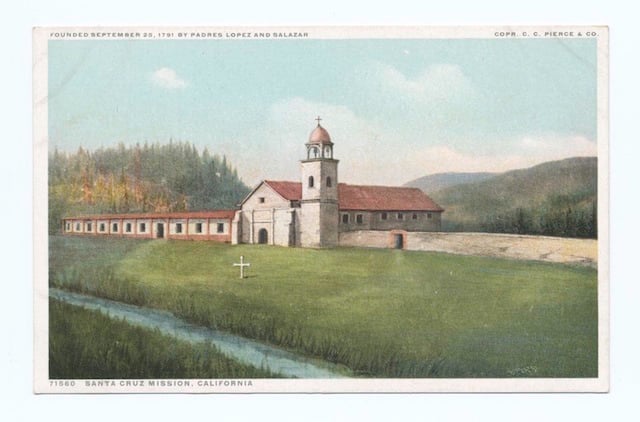
Postcard modeled after an 1853 painting of Mission Santa Cruz by Frenchman Leon Trousset. The long, low building at left resembles the style of the Mission Adobe, one of Santa Cruz County’s last remaining historic adobes.
The first European settlement in the area was the Santa Cruz Mission, built on the hill overlooking present-day downtown Santa Cruz. Established in 1791 by Spanish priests, it was the 12th of 21 missions meant to form the foundation of a Spanish-style society in California. The Ohlone-speaking indigenous people who lived at and near the mission labored in the fields and orchards, milled flour, and worked crafts and trades such as weaving, spinning, blacksmithing, and leather tanning.
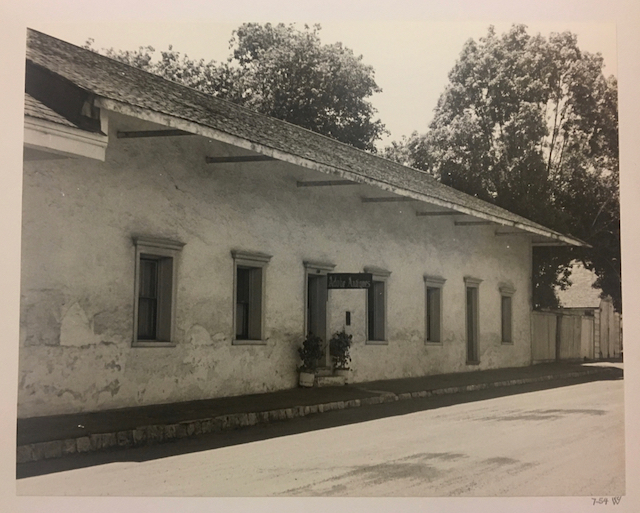
The Mission Adobe (also called the Neary-Rodriguez Adobe) as it was in 1954, when still occupied by residents and the Adobe Antiques shop. Photo by Van Court Warren, courtesy of the California State Library Historic Collection.
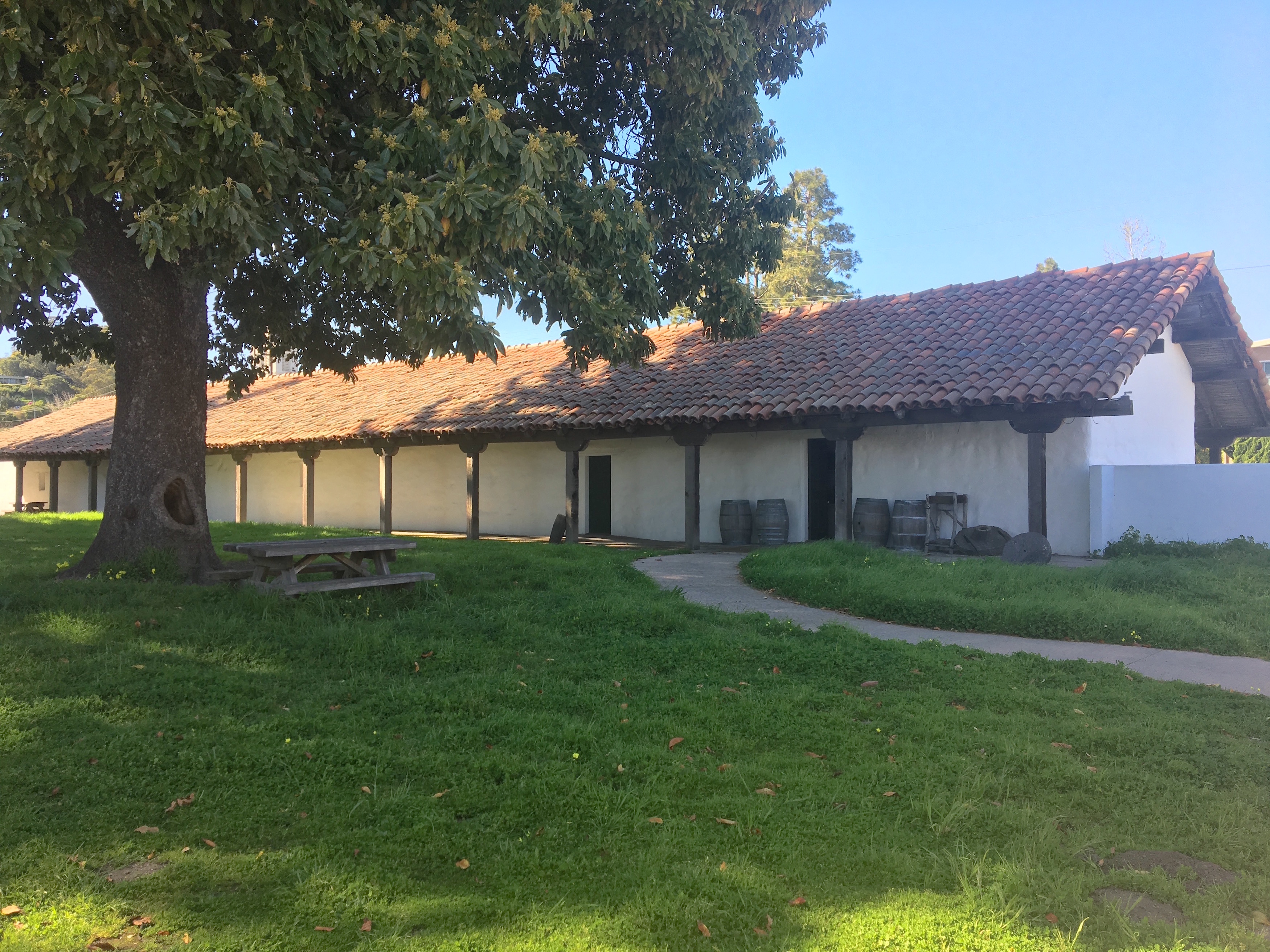
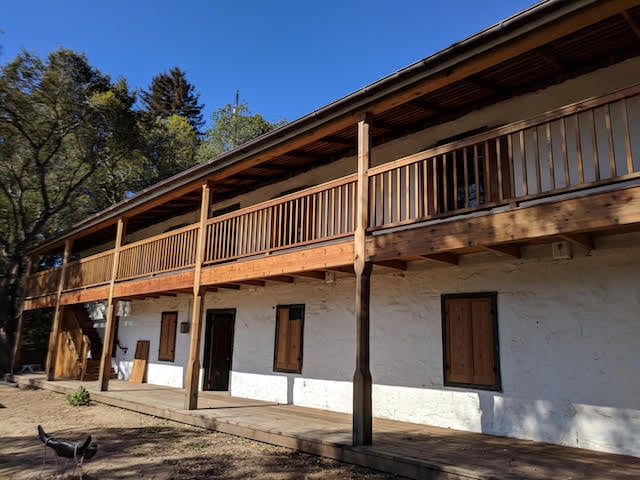
Today Mission Hill is the home of California’s only surviving example of mission housing for indigenous people. A kind of early apartment house, the Mission Adobe is a long, low-slung structure one room wide and seven rooms long (the original building had 17 rooms), with walls two feet thick in the classic adobe style. Built between 1822 and 1824, its construction mirrored that of a dormitory that stood across the creek (where School Street now runs). These dwellings housed indigenous artisans and craftspeople and their families.
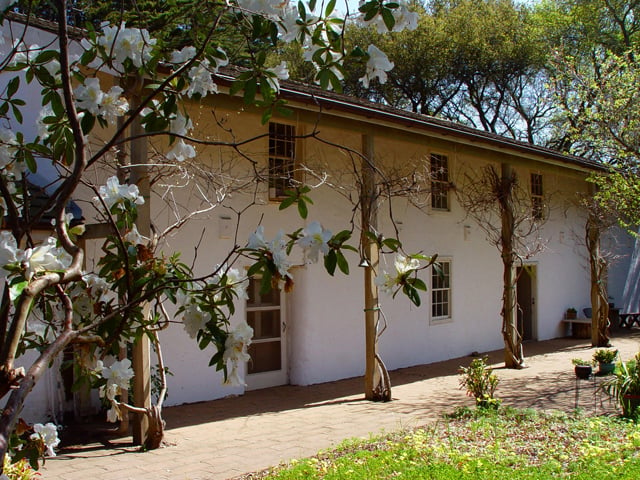
The Mission Adobe housed indigenous families during the Mission Era. It’s now a California state park. Traci Hukill photo.
Now the centerpiece of Santa Cruz Mission State Historic Park, the Mission Adobe contains a wealth of information about Ohlone lifeways, as well as the history of the adobe as it passed from generation to generation, miraculously surviving earthquakes and real estate booms. It’s all that remains of the mission complex that once sprawled across this bluff overlooking Monterey Bay. Fun fact: The avocado tree that stands in the courtyard is thought to be the second oldest in California.
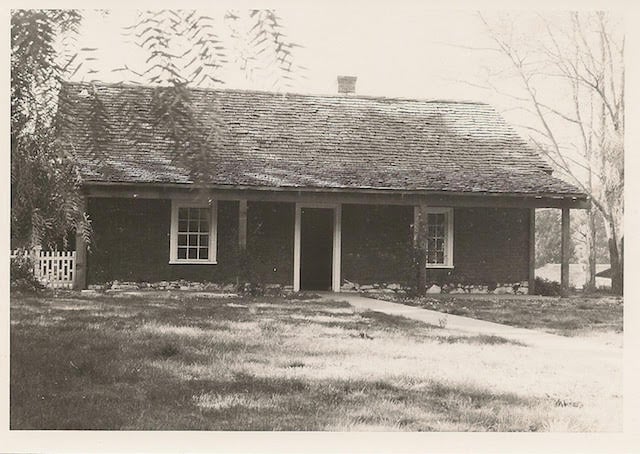
The privately owned Branciforte Adobe in 1975. It is one of the few historic adobes in California thought to have been continuously inhabited since construction. Photo: Edna E. Kimbro Archive, Friends of Santa Cruz State Parks.
The Branciforte Adobe
Not many people realize that Santa Cruz County is home to one
of just three civilian settlements built by the Spanish. Unlike the missions and
presidios with their religious and military functions, the pueblos were established as centrally planned farming communities
with plazas and zoning—places where ordinary civilian life could eventually
flourish. The first two pueblos were San Jose and Los Angeles. The third was
Villa de Branciforte, established in 1797 across the San Lorenzo River from the
six-year-old Mission Santa Cruz.
The Spanish authorities had grand plans for Villa de Branciforte,
but it was hard persuading residents of established towns in New Spain (i.e.,
Mexico) to move to the wilderness. The first eight settlers who arrived by ship
in Monterey from Guadalajara in May 1797 had been accused of petty crimes back in
Guadalajara. Life in Branciforte, where they’d been promised housing, livestock
and a stipend of $116 a year, was their ticket out of jail. Soon six young former soldiers joined them.
One of them was Joaquin Castro, a son of a family on the first De Anza
Expedition. The settlement kept growing and was eventually annexed to the city
of Santa Cruz in 1905.
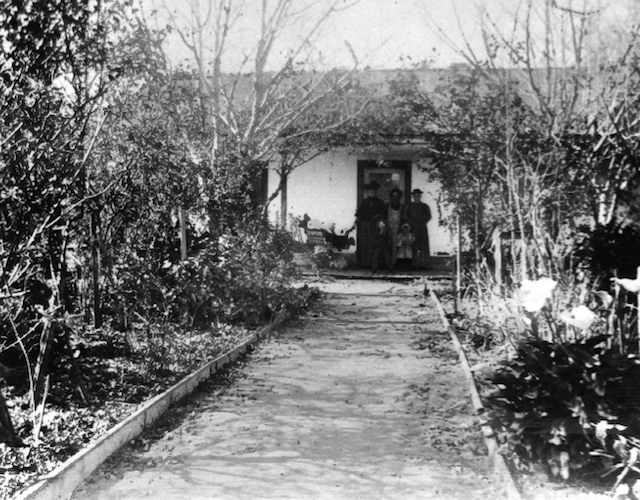
The Still family, who occupied the Branciforte Adobe from 1882 to 1920, in a 1902 photograph. Photo from the Edna E. Kimbro Archive, Friends of Santa Cruz State Parks.
We don’t know much about who built the Branciforte Adobe or when
it was built, but experts in adobe construction have suggested it was erected during
the Spanish period (1797-1821) and continuously inhabited ever since. Maybe its
first owners were fans of horseracing who wanted to be at the center of the
action; the road that is now North Branciforte Avenue doubled as a racetrack back
in Villa de Branciforte’s early days. Maybe the home was the scene of lively
parties; one former resident who lived there in the 1870s claimed to have heard
mysterious violin music emanating from the attic.
Today the Branciforte Adobe remains a private residence that
stands at the southwest corner of North Branciforte and Goss streets in Santa
Cruz, behind an adobe brick privacy wall. You can find the National Register
plaque nearby on North Branciforte Avenue.
Private residence;
please do not disturb occupants. North Branciforte and Goss streets, Santa
Cruz.
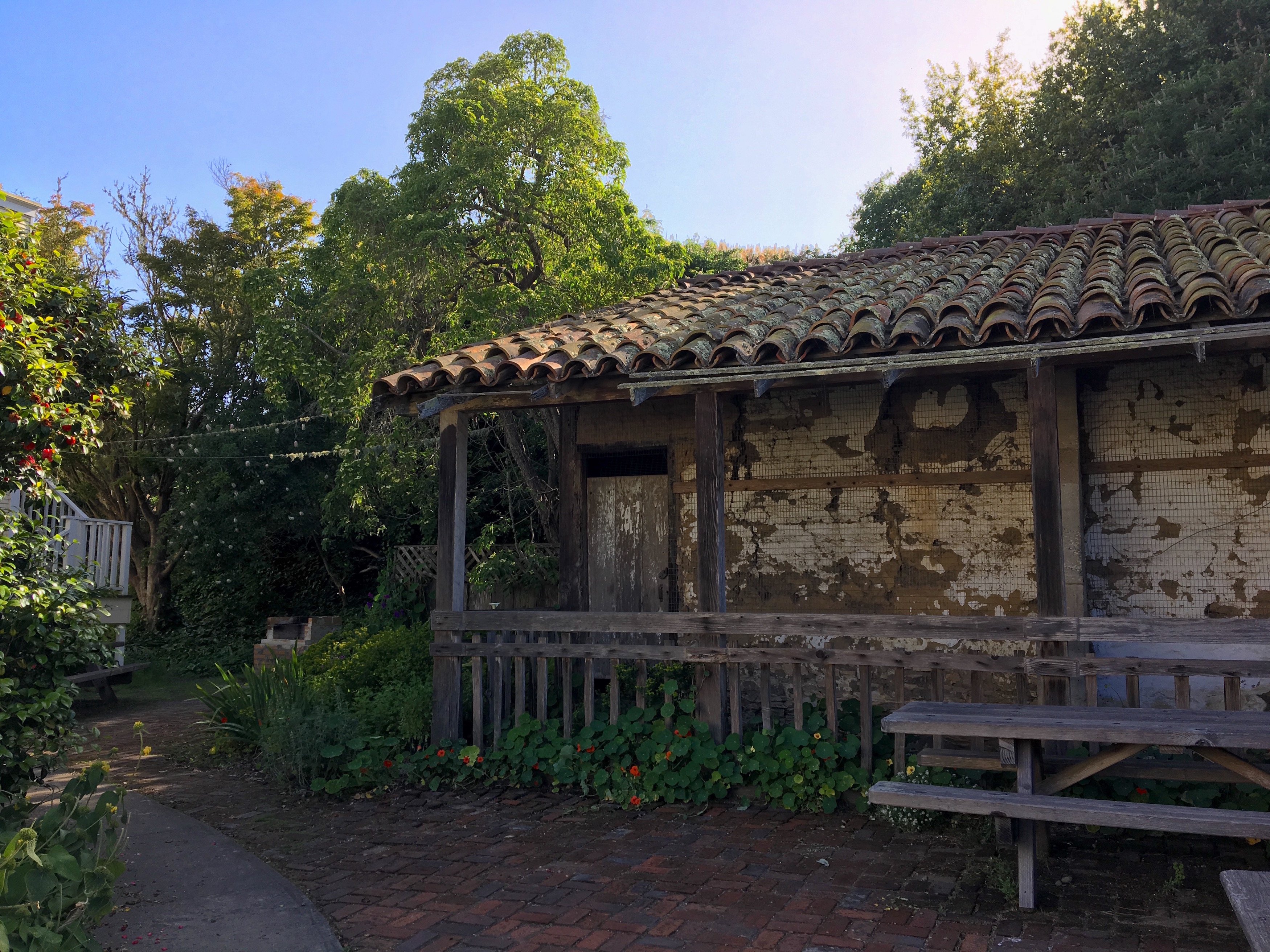
The Bolcoff Adobe at Wilder Ranch State Park was built around 1840 using materials (including the roof tiles) from the Santa Cruz Mission. Photo by Traci Hukill.
The Bolcoff Adobe
One of the most colorful citizens of early Santa Cruz County
was Jose Antonio Bolcoff, born Osip Volkov in Siberia in 1796. At the age of
19, Volkov deserted his Russian fur-trading ship when it anchored in the harbor
at Monterey. In short order he had won himself a place in the town’s Spanish
Californio society, working as an interpreter for the governor and taking a
Spanish name. Seven years later Bolcoff married the well-connected Maria
Candida Castro, the daughter of Joaquin Castro (the soldier who had settled in
Villa de Branciforte), and the couple moved to Villa de Branciforte. By 1833
Bolcoff was the alcalde, or mayor, of
the settlement.
The year 1839 was a big one for the Bolcoffs. Not only was Jose Bolcoff named administrator for Mission Santa Cruz—which had undergone secularization in 1834 and was being disassembled, piece by piece—but Maria Candida and her two younger sisters were given Rancho Refugio, a 12,000-acre land grant that includes what is now Wilder Ranch State Park. Jose and Maria Candida set up housekeeping at Rancho Refugio and built a home where the present-day parking lot is found. They also built the Bolcoff Adobe, believed to have been a farm building, using some of the beams and tiles from the Mission Santa Cruz.
By 1841, Jose Bolcoff’s name had mysteriously appeared on the Rancho Refugio grant, and the names of his wife‘s sisters had just as mysteriously disappeared. Decades later, in 1870, the U.S. Supreme Court ruled that the original grant had indeed been made to all three sisters and that Bolcoff had “suppressed or destroyed” the original and “fabricated” the new one. Read more about Wilder Ranch State Park.
Wilder Ranch State Park is located 15 minutes north of Downtown Santa Cruz on Highway 1, at 1401 Coast Road, Santa Cruz. Parking is $10.
The Castro Adobe, thought to have been built in 1848 or 1849, is the only two-story adobe in Santa Cruz County. In 2002 it was acquired by the State of California and is now a state park. Friends of Santa Cruz State Parks photo.
Unlike most historic adobes in California, which are found in cities or towns, the Castro Adobe is in a rural area, gracefully situated on a hill overlooking the Pajaro Valley and Monterey Bay. The Adobe’s idyllic, relatively undeveloped location makes it easy for visitors to vividly imagine life there in 1849 when historians believe the two-story home was constructed by Juan Jose Castro, the son of Joaquin Castro and brother of the rightful owners of Rancho Refugio.
Castro family legend has it that the house was built with
$30,000 from the gold fields. We may never know if that’s true, but unlike the
Easterners and Midwesterners who had to first get to California before setting
out for Gold Country, the Californios were able to race up to the Motherlode as
soon as gold was discovered at Sutter’s Mill and collect the easy pickings. In
any event, once built, the Castro Adobe was a center of social activity, with
feasts and entertainments, including bull-and-bear fights in the yard (it was a
different time) and fandangos on the second floor.
After statehood in 1850, the Castro family was beset by
lawsuits and eventually had to sell the family home. It passed through many
hands, at one point being used as a barn. It was remodeled many times.
In the 1980s an adobe historian named Edna Kimbro bought the Castro Adobe, and, although the Loma Prieta Earthquake of 1989 almost destroyed it — and definitely rendered it uninhabitable — she worked tirelessly to have it purchased by the State of California to be repaired and turned into a state park emblematic of the Mexican Era in California. The State completed the purchase in 2002, and the Friends of Santa Cruz State Parks spearheaded a massive rehabilitation effort that began in 2009.
Today the Castro Adobe is the focal point of Rancho San Andres Castro Adobe State Historic Park. Fully restored and up to code, it features a wheelchair-accessible lift to the second floor, brand-new first- and second-floor verandas, extensive seismic retrofitting (which is not easy to do with historic earthen structures; the story will delight engineers types), and a functioning brasero, or traditional cooking range, that schoolchildren use for making tortillas on field trips to learn about the Californio era. Read more about the Castro Adobe.
For spine-tingling tales and frightfully good fun, who you gonna call? Santa Cruz County has played host to hair-raising chills on the big screen, from the teen vampires of “The Lost Boys” to the scissor-wielding doppelgangers in “Us,” but the frights don’t have to end when the credits roll. Though famed for its sunny beach culture, Santa Cruz County hides a fun, spooky side with eerie cemeteries, creepy-cool Victorian mansions, and historic hotels rumored to house a few guests who’ve never checked out. Break out the Ecto Goggles, here’s where to get spooked in Santa Cruz County!
The Haunted Brookdale Lodge
Tucked in the tiny, redwood-forested town of Brookdale, the historic Brookdale Lodge is famed for its unique offerings: a creek running through its restaurant dining room, a see-through mermaid pool, and more than a few things that go bump in the night. The lodge has drawn ghost hunters and television crews from around the globe to investigate claims of unexplained apparitions, flickering lights, and whispering voices. Thought to have been originally built in 1890, The Brookdale Lodge would eventually become a glamorous, woodsy retreat for dignitaries and Hollywood celebs including President Herbert Hoover and Marilyn Monroe. Yet in recent years, it’s become famous for its otherworldly guests. One of the most frequently spotted figures is thought to be Sarah Logan, a ten-year-old relative of original owner James Harvey Logan who was found drowned in the creek in 1918. Numerous guests have reported seeing a young girl with braided blonde hair and a white dress wandering the halls or asking for help to find her mother. Over the years, the hotel’s staff have reported strange occurrences including footsteps and big band music heard in empty rooms, appliances turning on and off, and mysterious spots with cold sensations. Interested to sample the hotel’s hot and cold running chills? Book a stay at the recently renovated lodge in the woods!
The Missing Arm of William Waddell
While windsurfers and hikers are familiar with Waddell Beach and Waddell Valley, they might not know who the two scenic spots are named for. William Waddell was a 19th century landowner and businessman who operated a lumber mill in what is now his namesake valley. The successful lumber baron met his demise via the dagger-like claws of a grizzly bear, a not uncommon site in 1875. Before succumbing to his wounds, Waddell’s arm was amputated and buried in a meadow, yet when associates went back to retrieve the appendage to be buried with Waddell’s body, they were unable to find it. Yet soon after, visitors to the valley noticed that some of their personal objects were disappearing, and they reached the obvious conclusion: the haunted appendage of William Waddell was snatching their items!
The richly atmospheric Evergreen Cemetery is the final resting place for a textbook’s worth of historical figures—pioneers, prospectors, and Civil War vets—whose graves are adorned with ornate headstones. Yet, the burial sites of many Chinese immigrants were marked by humble wooden crosses that were lost to time. In 2014, the Santa Cruz Museum of Art & History, which maintains Evergreen, erected a memorial gate to honor these oft-forgotten railroad workers, farmhands, and servants who helped build early Santa Cruz. The project was funded by former Chinatown resident George Ow Jr. who explained that the memorial served to acknowledge the spirits, who according to Chinese folklore, would remain unrested or angry otherwise. Evergreen Cemetery is open to the public, and autumn is an exceptionally scenic time to tour its forested, leaf-strewn grounds, pausing to unearth the stories of Santa Cruz’s early pioneers.
The Ghost of Arana Gulch
In addition to the scooters, strollers, and bicycles that frequent the paths of Arana Gulch—a hidden patch of green in eastern Santa Cruz—you might also spot a mysterious figure dressed in a long black coat and wide brim hat. Before becoming Santa Cruz’s most famous ghost, Andrew Jackson Sloan was riding his horse through the gulch in 1863 when he was accosted by three men who fatally gunned him down. The culprits were eventually served Old West justice via a jail cell or a noose. Yet thirty-two years later, a mother and daughter witnessed a ghostly apparition near the gulch, and described what they had seen to a man who had served on Sloan’s murder investigation. After hearing the mother and daughter’s detailed description, the man proclaimed that that they had just described A.J. Sloan. Since then, local residents have reported seeing the specter wandering the field, or hearing his heavy boots stomp across the decks of neighboring homes. While it’s not clear where the ghostly Sloan will next be seen, you can view the site of his earthly remains at Evergreen Cemetery.
Haunted Tuttle Mansion
Founded in 1868, the south county town of Watsonville is dotted with magnificent Victorian homes that hide forgotten tales. One such example is Tuttle Mansion, an imposing, blood-red home at 723 E. Lake Ave. that was built for the wealthy family of Morris B. Tuttle who made his fortune in agriculture. Despite the Tuttle’s prominence, the house was beset by alleged tragedies including murder, suicide, and a young child falling to his death inside the property’s well. As a result, previous residents claim the house has become a portal for restless spirits. In addition to unexplained disturbances within the home—it has since served as a complex for apartments and office space—Morris Tuttle has been spotted in the house’s second-story windows, gazing out over his former orchards.
The Spooky-Cool Victorians of Beach Hill
With throngs of tourists arriving via a newly built railroad that ran down Beach Street in the late 19th century, the adjacent Beach Hill neighborhood quickly filled with ornate luxury hotels and mansions. Today, you can take a self-guided walking tour of these grand buildings including a few that might leave you with goosebumps. At 80 Front Street, you’ll discover the former McCray Hotel whose 1910 façade supposedly inspired the Bates Mansion in Alfred Hitchcock’s “Psycho.” And, keep an eye out for the Golden Gate Villa at 924 Third Street, a striking Queen Anne whose gorgeous stained glass windows belie the tragedy that took place here in 1907. Inside the home’s grand stairwell is a large stained glass depiction of Agnes McLaughlin, the adopted daughter of Major Frank McLaughlin, a prominent businessman who built the villa. The two enjoyed a life of luxury, yet by the early 20th century, the Major’s fortunes had plummeted. Overcome by shame and despair, the elder McLaughlin fatally shot his 33-year-old daughter while she slept, then proceeded to ingest a lethal dose of cyanide. McLaughlin left behind a note which explained his woes, and included one final, macabre request: that someone put his poor old cat to rest.
When it comes to iconic cars, all roads lead to Santa Cruz County. Cruise around town, and you’ll spot a variety of restored classics that will delight car buffs, gearheads, and Instagram husbands. Plus, beyond providing a fetching backdrop for social media pics, these timeless vehicles often offer a peek into the region’s cultural history. From surfboard-adorned Woodies to a delivery truck topped with a giant apple juice jug, here are seven spots to get revved up with classic autos.
With a mini tram that descends a scenic hillside overlooking Capitola Village to a dining room with babbling brook and mature trees sprouting through its dining room roof, Shadowbrook does everything on a grand scale. It’s little wonder that when the owners sought a car to shuttle diners to and from nearby hotels and homes—a solution to Capitola’s tight parking—they didn’t go with understated. The next time you’re craving classic menu items and cocktails, opt to arrive at the venerable restaurant in style via a green 1950 Dodge Meadowbrook or 1966 Yellow Checker Cab. The two restored taxis run every day during the busy summer season (Memorial Day – Labor Day) within a three-mile radius. Rides are complimentary, but tips are appreciated. Enthusiastic drivers often don newsboy caps and bow ties, and have become photography pros from snapping pics of dates, groups, and families. Just be sure to buckle up on the Checker Cab. It hides a souped-up V-8 Corvette engine under the hood!
One of the joys of visiting this famed Pleasant Valley vineyard is experiencing its serene, picturesque landscape. In addition to a tasting room which is open on select weekends throughout the year, guests can sign up for a safari-style tour of the rolling, oak and madrone-dotted property via a restored 1981 Land Rover Defender. The estate’s late owner, Dan Lester, was an avid international traveler and bon vivant, and the tour honors his spirit with a traditional South African sundowner, when wine and vittles are enjoyed atop a rugged vehicle in the countryside at sunset. At Lester Estates, guests are shuttled via the Land Rover to two scenic locations—a remote hillside overlooking the valley and a quiet meadow bounded by a redwood grove—where they sample wines paired with bites prepared by the winery’s resident chef. Safari tours are sold out for 2019, but guests are encouraged to check the website in spring 2020 for additional dates.
Greeting guests to Bargetto’s Soquel winery and tasting room is a vintage truck which a reminder of the landmark winery’s legacy. Founded on the day Prohibition was repealed, December 5, 1933, Bargetto is the oldest winery in the region. The 1936 Dodge truck was purchased new by co-founder Giovanni “John” Bargetto, and was originally used to deliver wine to the surrounding area. And, file this under “they don’t make ‘em like they used to:” the workhorse kept on trucking into the 1970s, hauling pomace from grape pressings.
To commemorate their 150th anniversary in 2017, the beloved juice producer Martinelli’s restored the last of their original delivery trucks, a 1932 Ford Model B flatbed. During the Great Depression, the company truck—emblazoned with the company’s memorable slogan, “Drink Your Apple a Day”—would transport apples, and deliver bottles to local vendors. The truck would also make special appearances at fairs, swapping the flatbed’s container stakes for an oversized replica of a Martinelli’s jug. Today, the restored vehicle sports a new engine and fresh coat of paint, and can often be seen at local parades and events.
Woodies on the Wharf is a beloved annual summer event that transforms the Santa Cruz Wharf into a waterfront expo for over 200 pristine, restored Woodies. What started as a casual meet-up between local Woody enthusiasts in 1994 has grown to become the largest event in Santa Cruz. Admission is free, and the public is invited to stroll a diverse collection of vintage, wood-paneled beauties while enjoying live music as well as fresh seafood from eateries that are just as classic as the sleek cars parked out front.
While many artists take inspiration from their surroundings, environmental artists incorporate the natural environs into their artworks, transforming the landscape into a virtual open-air gallery. You’ve seen examples: stacks of rocks precariously perched along trailways, and dazzling sand sculptures that lure camera-wielding crowds. The next time you’re out and about in Santa Cruz County, keep an eye out for the following artistic displays.
Enter Sandman
With nearly thirty miles of shoreline, Santa Cruz County’s most popular earth-based medium is available in droves. Visitors to Main Beach and Cowell Beach have likely enjoyed a sand sculpture by local artist Bill Lewis. These are not the everyday sandcastles that most of us quickly assemble with plastic buckets and repurposed coffee cups. Under the moniker Santa Cruz Sand, Lewis delights beachgoers with elaborate, sand-based creations such as sea creatures, vehicles, and holiday themes. “Most people visiting the beach won’t see a sea turtle or giant squid, but it is interesting to know they are out there,” says Lewis who recently shaped a 16-foot great white shark. Lewis’ sculptures can take anywhere from 3-7 hours to create, and are crafted using simple tools such as trowels, plastic utensils, a garden sprayer, and frisbee. In addition to sand, Lewis uses only materials found on the shore including sea water and shells to shape the creations that he hopes contribute to the beach’s sense of joy. “Visitors come here wanting to have a good time,” offers Lewis. “The sand sculptures capture the spirit of Santa Cruz. Its beach, beauty, and creativity.”
While Lewis often provides beachgoers with lighthearted fun, Cat McDaris’ beach designs reflect the ocean’s quiet, contemplative essence. Armed with a garden variety rake, McDaris can often be seen shaping bold, large-scale mandalas along the ebbing tide. If you’re lucky enough to catch one, you’ll appreciate how the ephemeral, zen-like nature of her creations can enhance an early morning stroll or inspiring sunset.
Each September, beachgoers also can marvel at numerous sand art creations sculpted at the Capitola Beach Festival. The second annual fest includes a sand sculpture contest that fills Capitola Beach with creative sculptures and displays. Think you’ve got the right stuff—and shovels—to craft your own creation? The public is encouraged to participate.
Rock of Ages
It’s not just sand art that’s filling photo streams. Images of rock art are stacking up, too. On social media, #rockstacking displays over 60,000 images of gravity-defying creations. Yet, it’s hardly a new trend. Stone stacking is a prehistoric tradition that spans cultures who used earthen piles to mark burial sites, serve as shrines, and aid navigation. Today, you’ll see still spy rock stacks—often referred to as cairns—used as direction markers along trails. Yet, the stacks that often attract the most attention are those skillfully constructed for aesthetic purposes. Each spring in Llano, Texas, master stackers from around the globe gather to compete in the rock stacking world championship.
Back in Santa Cruz, you’re likely to spy inspiring examples at locales such as West Cliff Drive. The seaside promenade is dotted with balanced rock stacks that coax pedestrians to pause and admire. Keep an eye out for these earthen artworks around Mitchell’s Cove, a scenic, pup-friendly beach. While many rock stacks serve as markers on unclear trail crossings, you’ll often see sculptural creations adding to the visual spectacle of natural features such as redwood groves and waterfalls. Watch for examples en route to Berry Creek Falls in Big Basin Redwoods State Park.
The most impressive rock display lies hidden in the Pogonip, a hillside open space preserve located alongside UC Santa Cruz. Situated behind historic, overgrown kilns found on the namesake Lime Kiln Trail, you’ll discover hundreds of wondrous stacks tucked into a moss-shrouded quarry. Meander carefully through the stacks, and you’ll notice personal notes tucked in between rocks by previous visitors. Bring a pad of paper and pen, and leave your own dedication!
Looking for more local art to rock your world? Check out our site to discover the many inspiring artists in Santa Cruz County.