Skip to content
Visit Santa Cruz County
  • Places to Stay
  • Places to Eat
    • Restaurants
    • Coffee, Tea & Sweets
    • Wineries, Taps & Tastings
  • Things to Do
    • Arts & Culture
    • Beach Boardwalk
    • Beaches & Parks
    • Outdoor & Wildlife
      • Request Wildlife Guide
      • View Wildlife Guide Online
    • Dog-Friendly
    • Upcoming Events
  • Plan Your Trip
    • Autism Travel
    • Contact Us
    • Frequently Asked Questions
    • Getting to Santa Cruz
    • Request a Visitor Magazine
    • View Visitor Magazine Online
    • View Map Online
    • Travel Itineraries
  • Lifestyle
    • Blog
    • Destinations
      • Aptos
      • Capitola/Soquel
      • Davenport
      • Pleasure Point
      • San Lorenzo Valley
      • Santa Cruz
      • Scotts Valley
      • Watsonville
      • Monterey Bay
SURF REPORT
LIVE CAMS
weather-icon 96°F
WEATHER
SEARCH
TRANSLATE
  • SECONDARY NAV
    • Meetings
    • International
    • Weddings
    • Film
    • Press Room
    • About Santa Cruz County
    • Relocation
    • Santa Cruz History
    • Visitor Safety Tips
TRANSLATE

Places to Stay

Places to Eat

Restaurants

Coffee, Tea + Sweets

Wineries Taps and Tastings

Things to Do

Arts & Culture

Beach Boardwalk

Beachs & Parks

Outdoor & Wildlife

Request Wildlife Guide

View Wildlife Guide Online

Dog-Friendly

Upcoming Events

FIFA World Cup 2026

Plan Your Trip

Contact Us

Getting to Santa Cruz

Request a Travel Guide

View Travel Guide Online

View Map Online

Travel Itineraries

Frequently Asked Questions

Lifestyle

Blog

Destinations

Aptos

Capitola/Soquel

Davenport

Pleasure Point

San Lorenzo Valley

Santa Cruz

Scotts Valley

Watsonville

Monterey Bay

Meetings

Film

Weddings

Press Room

About Santa Cruz County

Santa Cruz History

Relocation

SURF REPORT
LIVE CAMS
weather-icon 96°F
WEATHER
SEARCH
TRANSLATE
  • Where to Catch the Best Winter Sunsets

    It’s a scientific fact that sunsets are simply better in the winter. The colors are more vivid, the clouds sweep dramatically overhead like a painter’s bold brushstrokes, and in Santa Cruz where the ocean faces south, the bright yellow orb’s descent beneath the horizon is finally visible from almost any beach in the county. There are so many picturesque spots to capture the sun’s last rays and we’ve rounded up some of the very best! So, take a peek at the sunset magic and start planning your winter getaway to Santa Cruz County!

    1) PLEASURE POINT

    Vibrant pink & orange sunset

    Brooding pink sunset behind three palm trees

    Orange Sunset

    Whether you stay up on the cliffs or head down to the beach, Pleasure Point is a sunset seeker’s favorite. The winter pinks and oranges pop behind the palms. The pedestrian and wheel-friendly path along East Cliff Drive allows for the most rewarding evening strolls of the season.
    Location: East Cliff Drive, Santa Cruz

    2) DAVENPORT

    Winter sunset at Ano Nuevo State Park

    Take your pick from beaches along the coastal stretch of Highway 1 between Santa Cruz and Año Nuevo State Park. Davenport Landing Beach is easily accessible yet offers more solitude than the beaches within Santa Cruz city limits. Watch the sun sink into the waves from the ocean-view swing-set or walk your dog along the edge of the surf as the day comes to a close. Shark Fin Cove and Panther Beach are two other outstanding locations for winter sunsets. One drive on Highway 1 during a winter sunset and you’ll see – there are no bad views.
    Location: Davenport locations along Highway 1 between Santa Cruz and Año Nuevo

    3) WEST CLIFF
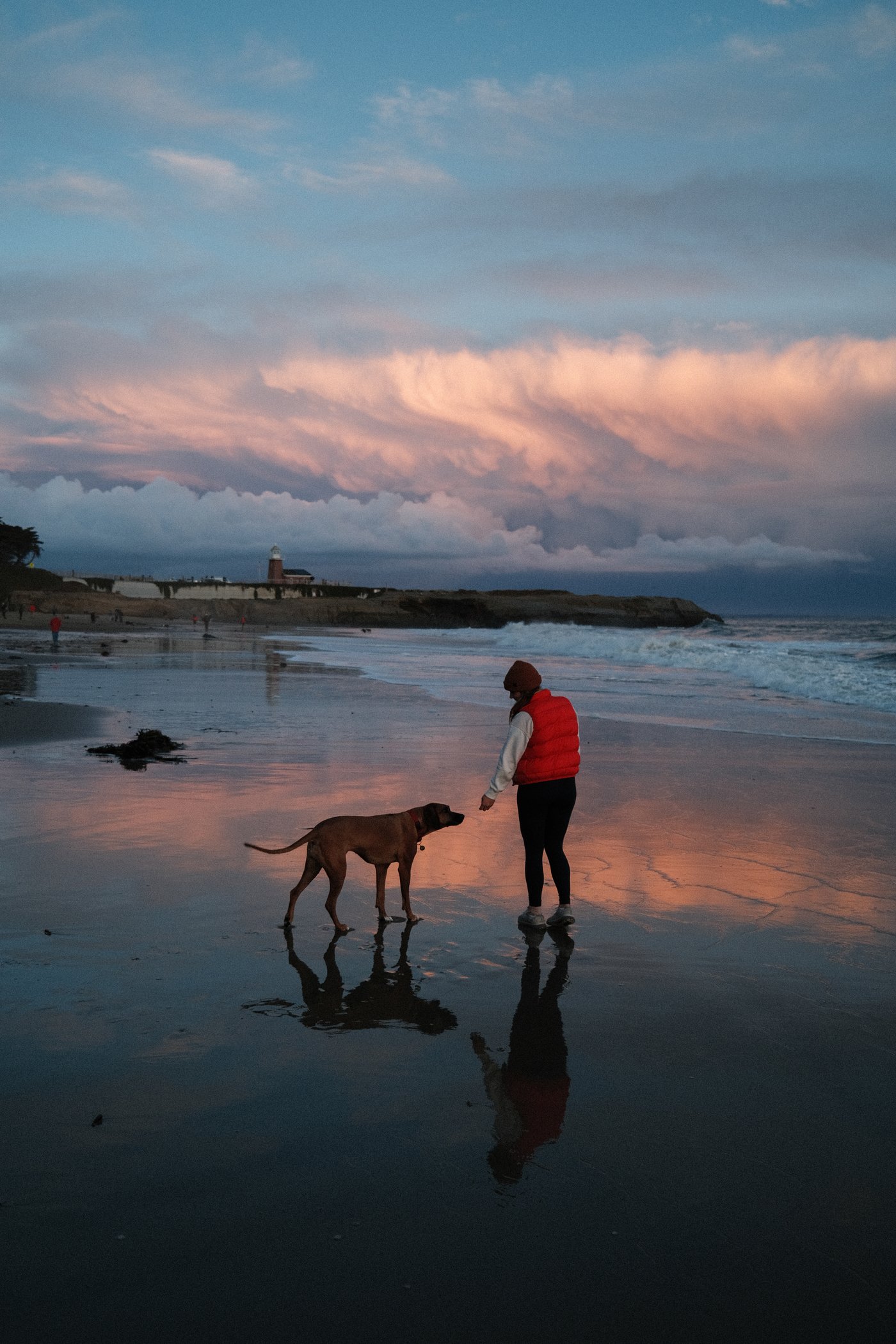
    Dog with their owner at Its Beach, known to locals as "Dog Beach"

    Aerial view of sunset over Steamer Lane

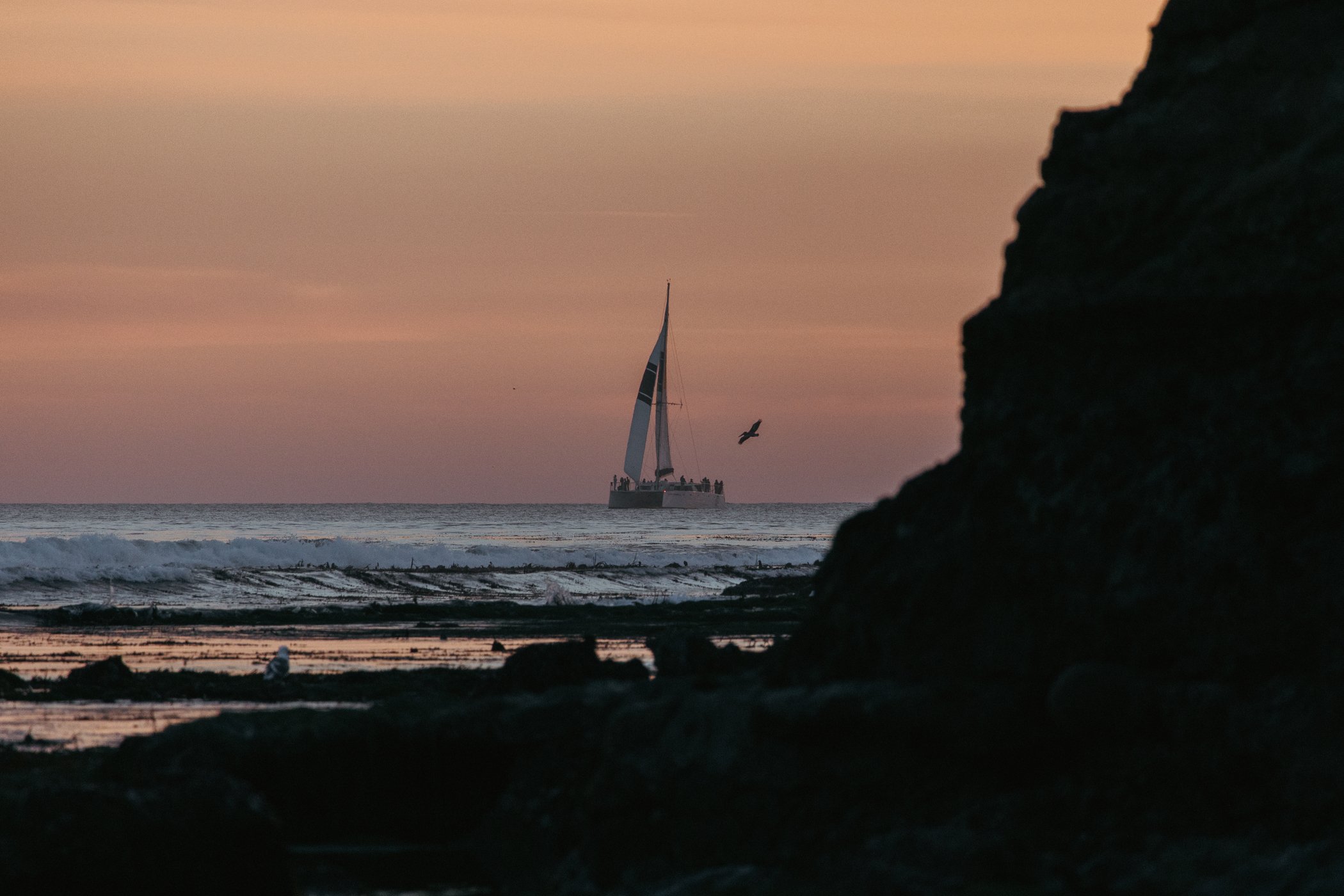
    Sailing at Sunset

    Enjoy the sunset on foot or bike along the paved path that stretches three breathtaking miles along West Cliff Drive. Take in striking ocean views as you pass by the Santa Cruz community from dog-walkers and joggers to surfers, hula-hoopers, and drummers. This is definitely a popular place to end a winter’s evening, but what it lacks in solitude, West Cliff more than makes up for in beauty.
    Location: Three coastal miles along West Cliff Drive, Santa Cruz

    4) NATURAL BRIDGES STATE BEACH

    Orange sunset at Natural Bridges State Beach

    Three rock arches once stretched into the surf at Natural Bridges State Beach but the wind and waves have worn all but one away. You can get a partial view of the single remaining arch from the parking lot above the beach, but the best vantage point is down by the waves on the beach. Once accessible by walking (and at one-time driving) from the parking lot at the end of West Cliff Drive, the natural arch is now a solitary island and a favorite resting spot for cormorants, pelicans, and gulls.
    Location: 2531 West Cliff Drive, Santa Cruz

    5) TWIN LAKES STATE BEACH

    Orange sunset at Twin Lakes State Beach with Walton Lighthouse

    Sunsets never grow old at Twin Lakes State Beach. With a view of two lighthouses, photographers can capture the sun setting over the distant Mark Abbott Lighthouse past the Santa Cruz Wharf and the moon rising over the picturesque Walton Lighthouse at the entrance to the harbor mouth. As the sun dips lower in the sky, the orange glow of a bonfire sparks into life at the far end of the beach and volleyball players pack up their nets and head home to dinner. Sailboats turn back towards shore and glide into the harbor, passing sea lions and otters on their way to the docks.
    Location: 2629-2601 E Cliff Drive, Santa Cruz

    6) RIO DEL MAR STATE BEACH / SEACLIFF STATE BEACH

    Orange sunset at the beach

    The beaches in Aptos, on the eastside of Santa Cruz County, stretch for miles and provide some of the widest views of the bay. Pack your tennis shoes and take a long run along the edge of the surf or just pack a hot thermos of tea and a blanket and hunker down to watch the show. Rio Del Mar State Beach and Seacliff State Beach seamlessly blend together on the scenic stretch of sand. The favorite view at Seacliff State Beach is of the SS Palo Alto, a WWI-era concrete ship. The sinking ship was built as a tanker for the war but was only ever used as an amusement center, complete with a dance hall, casino, and heated swimming pool. At sunset, as the sun dips the ship into silhouette, you can almost picture the Palo Alto in its heyday with throngs of stylish men and women strolling down the 630-foot pier to drink, gamble, and dance out on the waters of the Monterey Bay.
    Locations: Rio Del Mar State Beach: Beach Drive, Rio Del Mar / Seacliff State Beach: 201 State Park Drive, Aptos

    7) PAJARO DUNES / PALM STATE BEACH

    Sunset at Pajaro Dunes

    Savor the winter hues in the southern part of the county at Pajaro Dunes. The rolling sandhills, seagrasses, and miles of coastline make this the perfect locale for a long sunset walk along the shores. Surrounding beaches like Palm State Beach, Sunset State Beach, Manresa State Beach, and La Selva, make this a sunset lover’s paradise with lots of room to roam.
    Location: 2661 Beach Road, Watsonville

    8) CAPITOLA

    Orange sunset at Capitola Beach

    Whether you watch from the waves at New Brighton State Beach or from the patio at your favorite Village restaurant, Capitola is a winter sunset haven. From the waves, enjoy the bright pops of winter color with the silhouette of the cliffs. From the Capitola Village, enjoy the vibrant hues of the sky with the vibrant hues of the Village.

    Molly Ressler

    December 1, 2025
    Beaches, Parks, Things to Do
    best places to catch a sunset in santa cruz, best spots for a sunset in santa cruz, catch the sunset in santa cruz, santa cruz county, santa cruz county winter, santa cruz sunset, santa cruz sunsets, santa cruz winter, sunset in santa cruz, sunsets in santa cruz, visit santa cruz, visit santa cruz county, winter in santa cruz
  • Coastal Retreats to Soothe the Soul

    Take some time to relax and unwind along the rejuvenating coastline of Santa Cruz County, where the sounds of the waves lapping against the shore are sure to soothe the soul. Take a tranquil hike amidst the towering redwoods, breathing in the fresh mountain air. For those who need a bit of assistance to find nirvana, Santa Cruz offers a variety of therapeutic remedies, from massages and facials to sunset strolls on the sand, that will restore your body and soul.

    Photo and Header Photo | La Bahia Hotel & Spa | courtesy of La Bahia Hotel & Spa
    Photo and Header Photo | La Bahia Hotel & Spa | courtesy of La Bahia Hotel & Spa

    La Bahia Hotel & Spa

    Embracing the Santa Cruz coast, the La Bahia Hotel & Spa is the newest spot to capture some seaside serenity. This luxury resort features an onsite spa inspired by the original saltwater bathhouses of Santa Cruz in the mid-to late 1800’s. A stand-alone rooftop glass front sauna with ocean views can soft-launch your relaxation experience. The Moorish-designed spa derives inspiration from the rich sea life that calls the Monterey Bay National Marine Sanctuary home. Body treatments like the Tides of Tranquility massage – which ends with a sound bath – blends sea therapy, mindful massage, and vibrational sound, and facials utilizing light therapy, collagen-boosting radio frequency, marine botanicals and sea minerals among other resources are just some of the ways you can unwind at this sanctuary-above-the Sanctuary. Following your visit to the spa, put your feet up and unwind around a cozy fire pit or in a private cabana. Or merely relax and enjoy the ocean view on the Zen Deck, where the ocean provide a natural ambient sound garden. This area is utilized for wellness activities like sunrise yoga, mindful meditation sessions and sound baths, among other sessions, Soak in the rooftop hot tub overlooking the beach and enjoy a libation from the strategically-positioned The Plunge, a poolside oasis that is Instagram-friendly. Directly across from Main Beach, the La Bahia Hotel & Spa is 100 steps from the Santa Cruz Beach Boardwalk and yet a world away.

    Aerial view of Chaminade Resort & Spa

    Chaminade Resort & Spa

    Perched on a hilltop with 300 quiet acres offering breathtaking views of Monterey Bay, the Chaminade Resort & Spa has everything you need for a full day of pampering. Achieve pure relaxation with a full body massage and invigorate your skin with a facial or exfoliating body treatment. Breathe in the fresh mountain air, exploring miles of scenic hiking trails through the surrounding forest. Stop in post-hike to the fitness center, where you can loosen up your muscles in the heated pool, hot tubs, steam room, and sauna. When you’ve worked up an appetite, savor the seasonal fare at The View at Chaminade. Linger over your meal by the warmth of a fire overlooking acres of trees stretching down to the twinkling lights of Santa Cruz and the sparkling blue of the ocean below.

    Pajaro Dunes Resort on the beach

    Pajaro Dunes Resort

    Spread along miles of pristine California coastline, the Pajaro Dunes Resort promises a weekend of serenity. Escape the distractions and stresses of home in a luxurious beachside vacation rental just steps from the sand. Feel the weight lift off your shoulders as you decide whether to spend the day combing the shore, reading from your oceanview deck, or discovering the wildlife at Elkhorn Slough. You’ll find yourself slowing down to the pace of nature during your stay at this secluded retreat along the Monterey Bay.

    Seascape Beach Resort overlooking the ocean

    Seascape Beach Resort

    There’s no need to set an alarm at Seascape Beach Resort, where you can enjoy breakfast in bed before receiving your choice of relaxing In-Suite Spa Treatments, from a full body massage to a warm shell treatment, all within the comfort and privacy of your room. Let the soothing sounds of the ocean and the warm crackling of the fireplace lull you into the deepest state of relaxation. End this blissful day with a bonfire on the beach – s’mores included – or opt to stay in and enjoy the sunset from your private ocean view balcony.

    Dream Inn guest room with ocean view

    Dream Inn

    Unparalleled views of Monterey Bay await at the Dream Inn, where you can watch the sunset – or sunrise, if that’s your vibe – wrapped up in a plush robe on your own private balcony. Dive into relaxation at the only oceanfront hotel situated in the city of Santa Cruz, where you’ll gain access to the beachside heated pool, hot tub, and bar. Take a dip overlooking Cowell Beach and the historic Santa Cruz Wharf, sip on a poolside cocktail, and watch the waves from the comfort of a chaise lounge. There are even fire pits to keep the crisp ocean breeze at bay! Savor the sea’s offerings at the Jack O’Neill Restaurant and Lounge, where expertly crafted cocktails and a seasonally, regionally-driven menu embody the surf culture of Santa Cruz while offering spectacular seaside views. At the end of the day, the soothing sounds of the surf reach every retro-chic room, lulling you to a restful slumber that will leave you feeling rejuvenated.

    Front view of Courtyard by Marriott

    Courtyard by Marriott Santa Cruz

    Just blocks away from the hustle and bustle of the Santa Cruz Beach Boardwalk, a serene escape can be discovered at the Courtyard by Marriott Santa Cruz. After a day of fun in the sun, restore your energy with a revitalizing spa treatment from Spa Nalini. Enter a deep state of relaxation through massage therapy, facials, body exfoliation, and more. To end the evening, cozy up by one of the outdoor fire pits before snuggling into the plush bedding in your spacious room. You’ll leave the Courtyard by Marriott feeling well-rested and restored!

    Front view of Seacliff Inn

    Seacliff Inn

    Step into vacation mode at the Seacliff Inn, a coastal-cool haven where visitors can relax and recharge after a full day of exploring all that Santa Cruz County has to offer. Retreat to your room, where a plush bed and cozy amenities await! Unwind as you take in the garden views from your private patio, take a dip in the heated pool, and hop into the hot tub for a satisfying soak. Enjoy a bite on the relaxed outdoor patio at Sevy’s Bar + Kitchen, with views of a tranquil waterfall flowing into a koi pond below. For a more laid-back evening, you can order food and drinks to be delivered poolside. After the sun sets, settle into your sumptuous 300-thread-count sheets for a truly rejuvenating rest that’s sure to leave you feeling refreshed by morning.

    Soaking tub at Well Within Spa

    More Spa Treatments

    For those living locally or not staying at a property with spa-like amenities, find tranquility in a relaxing and restorative treatment at one of the spas around Santa Cruz County. A hidden gem in Downtown Santa Cruz, Yōso Wellness Spa is a green-certified business taking a holistic approach with “True Care from Skin to Soul” through facials, massage, acupuncture, oncology esthetics, eco-friendly nail services, lash extensions, waxing, and more! Their friendly and knowledgeable staff takes extreme care in their customers and the treatments and products they offer. Also Downtown, Tea House Spa and Well Within Spa are wonderful options for a spa day! Private hot tub rooms, saunas, and massages are offered at these long-standing retreats in the heart of Santa Cruz.

    Molly Ressler

    November 21, 2025
    Lifestyle, Vacation Ideas, Where to Stay
  • 5 Family-Friendly Ways to Vacation Like a Naturalist

    Vacations often involve cramming as many activities as possible into a three-day weekend. We zip through the local’s favorites, pose for selfies with the tourist attractions, and snap artfully arranged shots of avocado toast and acai bowls consumed between mugs of artisanal coffee. It’s all about checking things off our bucket list, filling our Instagram feed, and, for those with kids in tow, finding creative ways to avoid a meltdown.

    While we’re huge fans of both the bucket list and sharing experiences on social media, there is another way to experience both a new place and the familiar haunts you thought you knew like the back of your smartphone.

    View of the front of Santa Cruz Museum of Natural History

    It’s time to learn how to vacation (or staycation) like a naturalist with the Santa Cruz Museum of Natural History. We have five family-friendly steps from the Museum’s Executive Director, Felicia Van Stolk, that will help you and the kids slow down and explore a place with a new, acutely observant perspective. So, choose your destination, settle in, and vacation natural history-style. You might just discover a new type of adventure that’s both rejuvenating and surprisingly eye-opening. No scientific background required.

    Parent with their child exploring tide pools during King Tides

    Step #1: Be curious like Laura Hecox

    Felicia assures us you don’t have to be a professional scientist to be a naturalist. In fact, the Museum’s founder, Laura Hecox, was a self-trained naturalist. A Santa Cruz native who spent her childhood exploring every inch of Lighthouse Field, Hecox was naturally inquisitive and had a great eye for detail.

    “She was just curious,” says Felicia. “She would walk around the tide pools, comb the beaches, and look for things that didn’t belong or looked special. She found fossils, Native American artifacts like arrowheads. Her curiosity and the drive to just get out there and look was tremendous.”

    Seaweed on the beach

    Felicia describes a naturalist as “someone who notices things in nature, who looks for patterns, who gets to know a specific place.” You can be a naturalist who focuses on birds or you can focus on all the wildlife in one particular area like Seabright State Beach or Quail Hollow Ranch in Felton. “Mostly it’s making observations and noticing patterns on whatever topic that draws you.”

    Hecox was drawn to coastal environments and spent her days combing Seabright Beach in her petticoats and bustle, bent over the sand in search of fossils and unfamiliar crustaceans in the tide pools. An avid collector, her expansive collection of seashells, fossils, bird nests, dried sea stars, and countless other curios laid the foundation for the Santa Cruz Museum of Natural History (the city’s oldest museum) in 1905.

    Sea urchins during low tide at Kings Tide

    Step #2: Visit the Santa Cruz Museum of Natural History

    Once you’ve channeled your inner Laura Hecox, take your inquiring mind to the Museum. “Going to the Museum is a really great first step because you can see the potential of what’s out there,” says Felicia. “You might not see every animal on a hike but you’ll get an idea of what to look for.”

    The Museum’s permanent exhibits include the animal exhibit with coyotes, foxes, hawks, and everyone’s favorite, the crouching mountain lion. There’s also a tide pool exhibit with live sea stars, anemones, and rockfish. Visitors are welcome to both look and gently touch the variety of marine life.

    The Museum is a great opportunity to flex your still underdeveloped naturalist muscles. Try describing the anemone, barn owl, or shark jaw in detail to your friend, spouse, or child. Providing a detailed description of your findings will help you learn which field markings or details are important for accurate identification. According to Felicia, the practice of describing things in detail helps you notice more as well-an indispensable trait for a naturalist.

    Footprint imprints on the beach

    Step #3: Leave only footprints, take only pictures, rubbings, and imprints

    Once you’ve sufficiently stretched your observation muscles, head on out to your chosen location. It’s important to note at this stage that while the Museum greatly admires and appreciates the work of Laura Hecox, they discourage present-day naturalists from forming their own Hecox-inspired collections.

    “If every single person took a shell from the beach there would be no more shells,” Felicia cautions. “Whether or not a broken shell seems important to the beach ecosystem, it really is. Animals use it, shells break down and become part of the sand, and there’s something to be said for enjoying nature where it is.”

    Fossils seen during low tide

    While kids (and adults) love collecting seashells, there are other fun ways to create keepsakes. Put together a naturalist toolkit with clay, paper and pencils, and a camera (your smartphone will do) so you can record what you see. When you find a particularly interesting rock or shell, make an imprint with the clay to create your very own fossil. Or make a rubbing by placing a blank sheet of paper over the object and scribbling furiously with a pencil or crayon to capture its shape and patterns.

    Nature hikes

    Step #4: Use all your senses

    First, you need complete silence for 30 seconds. And yes, you can do this with little kids. Felicia does it with entire school groups all the time, so no excuses. During the silence, tell the kids to breathe deeply and see what they can smell. Then, bring the awareness to your skin. What do you feel? Is the air hot or cold? Dry or damp?

    One of Felicia’s favorite places for this game is Pogonip because of the wide variety of habitats in a relatively small area. The Museum takes 4th grade classes out to the city green space for sensory exploration activities, asking the students what they feel, smell, and hear, rather than only relying on what they can see.

    “When you move from a cold, wet redwood forest to a dry oak forest or to a meadow, they can really start to physically feel the difference of a place,” she explains.

    A Parent with their children exploring tidepools during low tide

    Step #5: Dress accordingly and pack some trail mix

    Constant whining about aching feet, rumbling stomachs, and soggy sneakers can ruin any vacation, but it can also prevent kids from cultivating a positive relationship with the outdoors. “If a kid is really uncomfortable, it can make or break their whole outlook on exploring nature,” Felicia warns.

    It’s all about attending to the basics, she says, and that includes dressing in layers (don’t forget to pack your flannel and puffy jacket) so no one’s too hot or too cold. Come prepared to your naturalist outing with snacks and water. Bring sun hats and sunscreen to the beach and make sure the kids have comfortable shoes if you plan to hike in the redwoods.

    And don’t forget to bring an endless supply of curiosity and wonder. You’ll need a lot of that.

    Molly Ressler

    October 19, 2023
    Beaches, Family Fun, Hiking, Outdoor + Wildlife, Parks, Things to Do
    family friendly, family fun, felicia van stolk, hike, Hiking, kid friendly, laura hecox, museum, natural history, naturalist, pogonip, santa cruz, santa cruz county, santa cruz museum of natural history, seabright beach, tide pool
  • Eat Like a Local: A Foodies History Tour of Santa Cruz County

    Everyone loves tasting the local cuisine when they visit somewhere new. Vacation, after all, is the perfect excuse to indulge and sample the variety of food and beverages a region is known for. With its rich soil and moderate climate, Santa Cruz County is an agricultural mecca with fertile fields of strawberries, tomatoes, artichokes, Brussels sprouts, vineyards, and apple orchards. It’s one thing to Yelp your way through each meal and snack break, but to truly savor each bite, you need to know the stories behind the food fueling your weekend adventure.

    Liz Birnbaum, one of four authors of Harvesting Our Heritage: Bite Size Stories from Santa Cruz County and founder of The Curated Feast, shared some of her favorite foodie facts that will amplify your Santa Cruz eating experience. We’ve added our own present-day culinary recommendations to create a two-day food tour of Santa Cruz that’s as mouthwatering as it is eye-opening. So, go ahead and eat your way through the weekend while learning about the rich food heritage that’s been shaping our county for generations.

    DOWNTOWN’S OFFICIAL DISH

    Saturday, Stop 1: Downtown Santa Cruz, Abbott Square
    What to Order: Potato Balls from Veg on the Edge and the Local Loaf from Cat. Cloud. Companion

    As you munch on the fried potato balls at Veg on the Edge, make sure to give thanks to those delectable spuds for their role in establishing Downtown Santa Cruz. “Downtown is here because of potatoes,” says Birnbaum. “How can we be sitting here and not reflect on this alluvial floodplain that provided a really fertile place to grow?” The first Santa Cruz crop commercially grown after the Missions, potatoes were responsible for putting the area on the map as an agricultural hub. Here’s a short summary:   

    Back in the mid-1800s, when ambitious men were flooding into California to mine for gold, an entrepreneur named Elihu Anthony staked his fortune in farming. He discovered that the site of present-day Downtown Santa Cruz could grow giant five-pound potatoes and he could sell them for an exorbitant price. The rush to profit off potatoes eventually caused the market to crash, but not before convincing many of the miners that the fertile soils of Santa Cruz were a smart place to put down roots.

    When you finish your potato balls, get another taste of Santa Cruz next door at Cat. Cloud. Companion. Their hearty Local Loaf is baked with whole wheat from the UC Santa Cruz Farm where they grow six-grain varieties, including quinoa. Pie Ranch, 10 miles north of Davenport, also grows its own grains and even has its own flour mill. They sell bags of their whole-wheat flour at their farm stand along with pies from Companion Bakeshop. The pies all feature locally grown whole wheat crust and rhubarb, strawberries, squash, chard, and eggs from Pie Ranch.

    MOO COW ICE CREAM

    Saturday, Stop 2: The Penny Ice Creamery
    What to Order: Any flavor with locally farmed ingredients

    From 1860 to 1960 there were about 100 dairies in the Santa Cruz region, known not for their cheese, but for their butters and creams. Brown Ranch, located on five acres where people now shop for the latest styles at the Capitola Mall, was one of the most successful. The ranch’s ‘Moo Cow Ice Cream’ was served in the dining cars of the Southern Pacific Railroad and on cruise ships that crossed the globe.

    Moo Cow Ice Cream is no longer in business, but Santa Cruz has several other ice creameries to choose from. The Penny Ice Creamery is the only one, however, that makes their cold confection entirely from scratch and serves experimental flavors featuring ingredients from local farms. The menu changes seasonally so there’s always an excuse to go back for more. In the summer, try their Straight Up Strawberry, Rose Petal Nectarine, or Crème Fraiche Rhubarb.

    A FAMILY-FRIENDLY TASTING FLIGHT

    Sunday, Stop 1: Martinelli’s Company Store
    What to Order: Sparkling apple cider tasting flight

    In Birnbaum’s opinion (a Chicago-native), the Apple Annual was Watsonville’s version of the Chicago World’s Fair. From 1910-1913, the Apple Annual was held over four days filled with parades, dances, vaudeville acts, and literally millions of apples. (2,350,000 in 1910 to be exact.) The event also included impressive replicas of local buildings and world-famous structures like the Panama Canal constructed entirely of apples.

    As many as 40,000 visitors attended the event over its three-year run. Although we no longer have an Apple Annual, Wilder Ranch holds an annual Heritage Harvest Festival each fall where you can taste dozens of local apple varieties and vote for your favorite.

    “I think of that era as the pre-Disneyland era,” says Birnbaum. “They had to figure out what exhibits would draw people in. To have two million apples and these small-world replicas is just incredible to me.”

    Today, 95 percent of Santa Cruz apples are sold to make juice and the region is known for the sparkling variety, in particular. In 1868, a Swiss man named Stephen Martinelli began his cider-making business. It began as alcoholic cider but when Prohibition took effect, he made the switch to non-alcoholic sparkling cider and never looked back. Martinelli’s is now sold across the world but still only produced right here in Watsonville. Get the full story at Martinelli’s Company Store and try the family-friendly tasting flight while you’re there. (Don’t miss the apple-mango!)

    SUN-KISSED STRAWBERRIES

    Sunday, Stop 2: Live Earth Farm
    What to Order: Strawberry U-pick (when in season)

    Commercial strawberries didn’t really take off in Santa Cruz until the early 1900s, but by the start of the 21st century, Santa Cruz was known for producing some of the best berries in the world. At the 2008 Olympics in Beijing, China, the athletes demanded three main types of fruit, and one of those was strawberries. Driscoll’s and California Giant leaped at the opportunity to showcase the region’s sweetest crop and shipped Pajaro Valley strawberries across the world to satisfy the Olympians’ cravings.

    Today, you can pick your own strawberries at local farms like Live Earth Farm in Watsonville starting mid-May. Bring your own berry basket or bucket (or pay a small fee to use one of the farm’s) and end your foodie tour by strolling through sun-kissed strawberry fields against the peaceful backdrop of the rolling Pajaro Hills.

    Want to extend your food tour? Find Harvesting Our Heritage, written by Liz Birnbaum, Jody Biergiel Colclough, Katie Lang Hansen, and Sierra Ryan, at the Museum of Art & History or at Bookshop Santa Cruz. All proceeds from the book go to the Museum.

    Birnbaum is also planning more memorable dining experiences through The Curated Feast.  Feast attendees can expect a flavorful journey set in a unique Santa Cruz location. Each dish is accompanied by spellbinding storytelling from Birnbaum of the food’s histories and mythologies.

    Molly Ressler

    May 8, 2022
    Arts + Culture, Food & Drink, Lifestyle
  • Where to Find the Best Wildflowers in Santa Cruz County

    It happens every spring, but the transformation of a green hillside to a bright carpet of orange, purple, or golden blooms never gets old. The fields bordering Highway 1 north of Santa Cruz turn bright yellow with sour grass and mustard. Cheery orange California poppies pop up along the San Lorenzo River and striking spires of lupine create varying brush strokes of amethyst, violet, and fuchsia along the coast and in the mountains.

    The wide variety of ecosystems in Santa Cruz County, from redwood forests to the rare Santa Cruz Sandhills, creates a wonderland of wildflower blooms from mid-March through June. Any hike will reward you with a unique bouquet of blooms but some trails are known for putting on an especially good show.

    Field of Wild Radish Wilder Ranch at Wilder Ranch

    Wilder Ranch

    Engelsman Loop starting on the inland side of Wilder Ranch State Park is your best bet for showy blooms. Look for the purple petals of Sky Lupine and Western Blue Eyed Grass mixed with California Poppies and Buttercups in the open, sunny chaparral. In the shade of the coastal redwood canopy, lush carpets of Redwood Sorrel with delicate pink and white flowers border the narrow path. Also look for the Redwood Violet and pointed petals of the tiny Western Starflower. If you’re lucky, you may find the delicate nodding blossom of the elusive Calochortus albus, also known as the Fairy Lantern or Globe Lily.

    A deer amidst lupines at Henry Cowell Sandhills

    Henry Cowell Sandhills

    The Santa Cruz Sandhills in Henry Cowell State Park are endemic to Santa Cruz County, meaning this unique ecosystem is only found in our coastal corner of the world. The sandhills are just as they sound, making this an especially fun hike for little ones who may rather be at the beach. And they’ll love the fact that 15 million years ago, the Santa Cruz Sandhills were at the bottom of the ocean. Today, this ‘beach’ in the mountains is home to several plants and animals found nowhere else. Keep your eyes peeled for the Santa Cruz Wallflower, Ben Lomond Spineflower, Ben Lomond Buckwheat, and Bonny Doon Manzanita. Although found throughout Santa Cruz County, the orange blooms of the Sticky Monkey Flower also love the sandy soil and full sun of this strange ecosystem.

    Quail Hollow Ranch house

    Quail Hollow Ranch

    Although Quail Hollow Ranch only has 4.5 miles of hiking trails, this 300 acre park packs a lot into its small footprint. Explore Santa Cruz Sandhills, a dwarf redwood forest, and a sunny meadow lush with lupine, Scarlet Pimpernel, and eye-catching fuschia splashes of Tiny Red Maids. Fun fact: The grounds of Quail Hollow were once home to the test gardens of Sunset Magazine and the ranch house was home to its test kitchen.

    Santa Cruz Museum of Natural History’

    Urban Wildflower Oases

    For a quick sampling of Santa Cruz County wildflowers—no hiking required—pay a visit to the Santa Cruz Museum of Natural History’s native plant garden. Take a self-guided tour of the Museum’s outer perimeter and the banks above Pilkington Creek to find Common Yarrow, Sticky Monkey Flower, Blue Dicks, Flannelbush, California Sagebrush, and Lizard Tail. Walk the cliff trail behind the Seymour Marine Discovery Center for an impressive display of native coastal bluff species.

    Crashing wave and wildflowers at East Cliff Drive

    For more urban wildflowers, walk (or even drive) ocean side on East Cliff Drive in Pleasure Point or on West Cliff Drive in Santa Cruz.

    Super Blooms Call for Super State Park Visitors

    To help preserve these incredible floral landscapes for everyone to enjoy, make sure you’re well informed of state park rules before going on your wildflower adventure.

    For instance, you can stop and smell and photograph the flowers to your heart’s delight, but picking a bouquet of wildflowers can damage fragile ecosystems and diminish the natural beauty for other hikers. (It’s also against the law to take anything from state parks, from flowers to driftwood.) And while it’s tempting, frolicking in a field of lupine or spreading a picnic blanket across a carpet of baby blue Forget Me Nots also disturbs the natural landscape, so keep your frolicking and picnicking to designated trails.

    Watch this short video from California State Parks for more tips on treading gently in wildflower areas and make sure to read up on their hiking safety tips and where to find the best blooms throughout California.

    Molly Ressler

    April 6, 2019
    Hiking, Parks, Things to Do
  • Top Mountain Biking Trails in Santa Cruz County

    While surfing may have first put Santa Cruz on the map, there’s a landlocked sport that’s been gaining traction and attracting international attention over the last couple decades. The epicenter of mountain biking sits right here in “Surf City” with year-round riding conditions and world-class trails just minutes from your home or hotel room.

    Whether you’re brand new to the sport or you grew up shredding singletracks, there’s a trail for you in Santa Cruz. We asked Emma Ussat of Mountain Bikers of Santa Cruz (MBOSC), Ibis frame designer Roxy Lo and Girls Rock Board Vice President Alexis Morgan to share their favorite trails in the area, how to get into the sport, and how to bike responsibly so that you respect both fellow riders and the trails.

    BEST TRAIL FOR BEGINNERS: EMMA MCCRARY

    Located in Pogonip park just a few minutes from downtown and the University, the Emma McCrary Trail first winds through a mix of oak and bay forest, along a burbling creek crossed twice by sturdy wooden bridges. The trail then gently climbs into the cool redwood forest before connecting to the more challenging Rincon and U-con trail at the top.

    “Emma McCrary is a fantastic beginner route for an out and back that’s very accessible,” says Morgan. “It’s a lot of fun and very user friendly.”

    This fun, forgiving flow trail (a continuous flowing ride with very little pedaling required) is also the most sustainable trail in Santa Cruz, even with 80,000 trips a year. Built in March 2012 by 300+ volunteers who donated over 3,500 hours of trail work, the trail’s design includes berms, jumps, and rollers (packed dirt mounds that create intentional bumps to ride over in the trail) with built-in drainage to minimize erosion.

    “Every time I ride Emma McCrary I like it even more,” says Ussat. “It’s just super awesome, super fun, and flows really well. I love how you can have fun going uphill and downhill because it’s not super steep.”

    For beginners seeking a doubletrack with little to no inclines, the first 4.5 miles of the Aptos Creek Fire Road in Nisene Marks State Park is an easy, flat option for inexperienced riders. There’s also the Old Cove Landing Trail along the coast in Wilder Ranch State Park with endless ocean views.

    BEST TRAIL FOR ADVANCED RIDERS: SOQUEL DEMONSTRATION FOREST

    All Santa Cruz mountain biking trails are multi-use but on the Soquel Demonstration Forest Flow Trail bikers dominate the landscape. Located in Nisene Marks State Park, the mountain biking review site Singletracks rated this dirt-packed rollercoaster the #1 flow trail in the U.S.

    Prepare for long climbs and challenging technical drops (although Ussat assures us you can avoid these if you’re in over your head) in addition to the many berms, jumps, and rollers on this popular ride.

    TRAIL WITH THE BEST VIEWS: WILDER RIDGE LOOP

    The 4-mile Wilder Ridge Loop in Wilder Ranch State Park climbs through coastal grasslands dotted with wildflowers and rewards bikers with stunning views of the glimmering blue Pacific. If you’re looking for a longer trek, you can connect to several trails, including Baldwin Loop and the enticingly named Enchanted Loop (see below).

    MOST DIVERSE TRAIL: THE OLD CABIN CLASSIC

    Starting on the ocean-side of Wilder State Park near the historic dairy ranch, The Old Cabin Classic (technically not a trail but the route of a race that takes place every May) offers 11 miles of riding through chaparral, oak woodlands, open coastal prairie, and shady redwoods.

    “Wilder incorporates challenging climbing, beautiful vistas, and really fun, challenging drops and turns that go through the Enchanted Loop (my favorite trail),” says Morgan.

    While Morgan’s favorite trail may not offer big, sweeping vistas, the Enchanted Loop is blissfully quiet and pleasantly shaded. The singletrack cuts through lush carpets of redwood clover beneath a canopy of Sequoia sempervirens. The MBOSC also did a reroute of the climb in 2016 to restore a badly eroded section and improve the riding experience.

    “It has a really fun technical descent that goes through towering bay trees and madrones down into the valley,” explains Ussat, “Then you go through the fern gulley and you take this really mellow, beautiful climb back to the top.”

    OTHER TRAILS WORTH RIDING

    Henry Cowell State Park (fire roads only)
    DeLaveaga Park
    University of California Santa Cruz (fire roads only)

    (For a full list of legal trails, pump tracks and bike parks in Santa Cruz County, check out MBOSC’s website.)

    GUIDED MOUNTAIN BIKING TOURS

    Some bikers prefer planning their own adventure, but sometimes it’s nice to have a seasoned (and first-aid-certified) guide to show you the ropes. With Ride the Redwoods, whether you’re looking for an cross country ride with ocean views, an adrenaline gravity fueled rip on some more technical tracks, or maybe a mixture of both, they’ve got you covered. In addition to thrilling guided rides of spectacular singletrack, Ride the Redwoods also provides individual and group instruction for riding skills development.

    Another great option is The Ride Guides. With over 20 years of experience, The Ride Guides’ team of professional mountain biking guides and coaches are committed to helping you discover your dream trail among Santa Cruz’s superlative singletrack. They’re passionate about Santa Cruz’s environment, from the redwood forests to the Monterey Bay National Marine Sanctuary, and eager to share it with our guests. First-time mountain biker looking to develop a few skills and explore the coast or a seasoned rider looking to challenge yourself on our loamy mountain trails, they’ll customize a tour to suit your needs.

    If you’re just looking for someone to ride with, Girls Rock holds public rides every month, weather depending. When it’s too wet to ride, the MBOSC-hosted Dig Days are a great way to meet new friends and help maintain the trails you love.

    WHERE TO RENT A BIKE

    Santa Cruz not only has 11 bike shops but is also home to leading mountain bike manufacturers like Santa Cruz Bicycles, Ibis, Juliana, and Specialized. For rentals, check out Epicenter Cycling in Aptos, Another Bike Shop on the Westside, Spokesman downtown, or the Family Cycling Center in Pleasure Point.

    If you want a little extra help pedaling up those hills, Current eBikes has a selection of electric mountain bikes. Just make sure you do your research first as electric bikes aren’t allowed on all the trails.

    TIPS FOR MOUNTAIN BIKING RESPONSIBLY

    Stick to legal trails. The first thing riders should know about mountain biking in Santa Cruz is that not all trails found online are legal. Lo, Ussat, and Morgan all stress the importance of staying on legal trails to help cultivate a culture in Santa Cruz that’s friendly and welcoming to the mountain biking community. MBOSC has worked directly with the City on a number of projects to create more legitimate trail access for mountain bikers.

    Check conditions. Trails are periodically closed due to storm damage, maintenance, or for prescribed burns which are relatively common in Wilder. To find out whether a trail is open you can call a local bike shop or check MBOSC’s website or social media channels.

    When it’s wet, grab a beer instead. Tip number three is avoid biking in the rain and the mud. Despite what most people think this is a) not all that fun and b) bad for the trail and bad for your bike. Riding on wet dirt not only tears up the trail and causes erosion, it’s also bad for you and your bike. The rain and mud wears down the bike’s components and slippery conditions can lead to bad falls and nasty injuries. We say this is the perfect excuse for a hike & beer combo.

    Be prepared. Lo reminds riders that it’s up to you to watch out for yourself when you go out on rides in the forest, so plan accordingly. “You’re pretty much fending for yourself out there so be safe,” says Lo. She encourages bikers to go out with a riding buddy and to bring a map because cell service is unreliable on most trails.

    Keep it friendly. Last but not least, be respectful of other riders and trail users. “Remember that you’re not the only one using the trail,” says Ussat. “None of the trails are mountain bike specific-they’re all multi-use trails-so be nice and say hello to equestrians and hikers.”

    Molly Ressler

    March 14, 2019
    Parks, Sports & Recreation, Things to Do
    aptos creek fire road, Big Basin, bike, current ebikes, delaveaga, emma mccrary, forest, forest of nisene marks state park, girls rock, Henry Cowell, ibis, mountain bikers of santa cruz, Mountain Biking, nisene marks, old cabin classic, old cove trail at wilder, parks, pogonip, riding, rincon, santa cruz, santa cruz county, shuttle smith adventures, singletracks, soquel demonstration forest, state park, the ride guides, trail, UCSC, University of California Santa Cruz, Wilder Ranch, wilder ridge loop
  • Searching for Slugs in the Santa Cruz Mountains

    You haven’t fully experienced Santa Cruz County until you’ve hiked through a redwood forest still dripping from a hard rain. The canyons are filled with the sound of rushing water. Wrens flit between the lichen-draped brush of the understory, and the silvery warble of a Swainson’s thrush filters down from the latticework of branches spiraling hundreds of feet above your head. As a hiker, however, the most fascinating part of a rain-soaked coastal redwood forest is right beneath your feet. When the ground is well saturated, you don’t have to look hard to spot Santa Cruz’s favorite slimy gastropod, the banana slug. In fact, after a particularly hard rain, you may have to watch your step.

    During dry spells, banana slugs hunker down and go into their version of hibernation. This is why your best bet for seeing one is to get out into the forest while the ground’s still wet and there’s a winter chill in the air. Of course, most people don’t consider winter the best time for hiking, but with quieter trails, a rainbow of lichen and mushrooms, and roaring waterfalls that reduce to a trickle in summer, banana slugs are only one reason to venture outdoors in the “off-season.” Another bonus to exploring right after (or during) the rain—you just might share the trail with the California newt as well.

    Where to Find Banana Slugs in Santa Cruz County

    When choosing your hike, look for parks that are dominated by redwoods and have ample water—both things easy to find in Santa Cruz County which is partly why the slugs love it here. We also have a temperate climate with mild winters and summers that cater well to the slug’s sensitivity to extreme temperatures.

    Before venturing out on the trails, however, it’s important to check the State Park’s website for trail closures, especially in winter and early spring when storms can cause erosion, downed trees, and tricky creek crossings. For year-round, easy slug spotting adventures, Henry Cowell State Park offers kid-friendly hikes and wheelchair accessible jaunts beneath the redwoods. Nestled in the heart of Aptos, Nisene Marks State Park has winding trails that border a redwood creek canyon and miles of dog-friendly trails. Last but not least, Rancho Del Oso State Park, at the mouth of Waddell Creek, is a scenic drive up Highway 1 and also a great place to see both slugs and newts.

    Surprising Slug Facts

    While simply observing a banana slug in its natural habitat is a thrill, its strange biology, not to mention famous cultural ties, add a new level of appreciation to your slimy discovery. After all, we’re talking about the second largest slug in the world, stretching to a shocking 10 inches in length. (That’s the size of a cucumber or a women’s size 10 shoe!) Besides their incredible size, there are countless weird, fascinating facts about the banana slug that will leave you itching to get on the forest trails and scan the redwood duff for these giant slime rappelling, tongue numbing, hermaphroditic mollusks.  

    Slime is Their Secret Superpower

    A banana slug’s slime is no ordinary mucus. Somewhere between a liquid and a solid, it’s both an adhesive and a lubricant. Its stickiness allows banana slugs to ooze up tree trunks and rappel down from high branches on a rope of their own mucus. Its slipperiness keeps the slug from shriveling up like a raisin when the sun comes out and allows it to easily slide over the rough redwood duff, twigs, and sharp rocks on the forest floor. Pheromones found in their shimmery slime trails also help them to find other slug mates. As hermaphrodites, however, slugs don’t technically need a mate to reproduce, but most of them still choose to procreate the old-fashioned way.

    Most famously, banana slug slime contains an anesthetic that instantly numbs the tongue of hungry would-be predators and adventurous hikers. A word of caution to those with ‘kiss a banana slug’ on their bucket list. Even though it’s rumored to bring good fortune, even a small peck can transfer harmful bacteria to the slug’s organs. (Plus, it tastes horrible.) Their skin is extremely porous and readily absorbs any nutrients or chemicals it comes into contact with, including those found on your lips and skin. So, take all the banana slug selfies you want, but keep it clean and keep your hands to yourself.

    They Age Like a Banana

    The iconic banana slug that adorns UCSC schwag and dominates Instagram is a bright yellow that stands out amongst the deep browns and greens of their shady forest habitat. That Sammy-the-slug yellow, however, is only one stage in the terrestrial mollusk’s 7-year life cycle. Younger slugs may be bright and showy, but with age, the slug slowly fades to brown. What they eat, their health, and light exposure can also affect their color, resulting in a range of hues from green, black, and white to spotted.

    They Beat the Sea Lion as UCSC’s Official Mascot

    UCSC has always been known for its cultivation of individuality and for fostering a community of free thinkers who openly challenge the status quo. It’s only natural that their mascot would also push the envelope and stand out from the pack. The banana slug was chosen as the school’s unofficial mascot from its early beginnings, but in 1980 the chancellor hoped to make the switch to the more powerful and intimidating sea lion. The students rebelled, continuing to cheer for the slugs even after the chancellor painted the sea lion on the basketball court floor. In 1986 the mascot went up for a vote and the banana slug won by a landslide.

    Since then, Sammy the Slug has been voted one of the weirdest, best, and worst team mascots in college sports. He also made a cameo appearance in the cult classic Pulp Fiction when John Travolta sported the ‘OG’ UCSC banana slugs t-shirt. Pick up your own at the Bay Tree Bookstore on campus or downtown at Bookshop Santa Cruz.

    For more on all things wild in & around Santa Cruz, click here.

    Molly Ressler

    March 6, 2019
    Hiking, Outdoor + Wildlife, Things to Do
  • Best Eco-Friendly Eateries in Santa Cruz County

    Eating out in Santa Cruz County is about so much more than fueling up for the next adventure. The nation’s organic food movement took root here in our county’s fertile soil and we banned plastic bags, straws, cutlery and styrofoam take-out containers long before green-living and zero-waste lifestyles came into vogue.

    With this history and the acres of agricultural land right in our backyard, you could say that an abundance of farm-to-table restaurants comes with the territory. There are a few local eateries, however, that go above and beyond the required biodegradable take-out containers and expected organic produce. These restaurants plan their menus around the local harvest and are always looking for ways to further shrink their environmental footprint. The innovative culinary creations that result will elevate your dining experience from passive diner to passionate foodie with a taste for local cuisine and eco-conscious dining experiences.

    GOOD FOR YOUR HEALTH, WALLET, AND THE PLANET

    Charlie Hong Kong serves healthy Asian-Californian street food out of a 1950’s ice cream stand. A covered outdoor seating area sports an appropriately green awning to match their impressive list of green business practices. To start, there’s the vegan-friendly menu (although you can always add sustainable, hormone and antibiotic-free meat to any dish) featuring all-organic produce from local farms like Lakeside Organics. Popular dishes like the vegan Spicy Dan feature a medley of seasonal, and always organic vegetables. And if you’re at all worried about the coconut milk, owners Rudy and Carolyn Rudolph traveled all the way to Thailand to ensure the company met their environmental standards.

    A Green Certified Business, Charlie Hong Kong was the first business in Santa Cruz to stop using plastic takeout bags before the city or state’s plastic bag ban went into effect. Owner Carolyn Rudolph even partnered with local nonprofit Save Our Shores to help pass plastic bag ban ordinances in neighboring cities. It should come as no surprise then that you won’t find plastic water bottles in their cooler. Instead, choose from a variety of beers and non-alcoholic beverages in glass bottles and aluminum cans. Takeout orders include compostable cutlery, and for those who eat in, all dishes are served in reusable dishware—a rarity for a small, counter-service restaurant.

    OTHER GREEN RESTAURANTS WORTH A MENTION

    Many other restaurants in Santa Cruz County take sustainability seriously. Shadowbrook turned the roof of its kitchen into an organic herb garden and is part of the Monterey Bay Green Business Program. Discretion Brewing is the county’s first solar-powered and green-certified brewery and is also home to The Kitchen led by Chef Santos Majano. Humble Sea on the Westside frequently hosts events and brews beers that give back to environmental causes. They also feature locally grown produce from the Homeless Garden Project and other nearby farms in a rotating menu of mouthwatering sandwiches and salads.

    Your hotel may offer earth-friendly dining as well. The Solaire Restaurant at Hotel Paradox is also committed to local ingredients and a small carbon footprint. They even source hyper-local honey for their innovative cocktails from local hives.

    Molly Ressler

    December 3, 2018
    Food & Drink

Visit Santa Cruz County logo

Visit Santa Cruz County is a private, non-profit corporation, serving as the official visitor marketing entity for Santa Cruz County. Visit Santa Cruz County works to enhance tourism, the visitor experience, and the area economy by positioning and promoting Santa Cruz County as a year-around visitor, conference and film destination.

USA Brand USA Badge
Central Coast California Badge
VIsit California Badge
IBCCES Badge
Visitor Information Center

705 Front Street
Santa Cruz, CA 95060
(Next to Museum of Art & History)
800.833.3494 or  831.425.1234

Hours
Open Daily
10:00 a.m. – 4:00 p.m.

contact us⟶
Visitor Magazine Cover Footer
free visitor magazine⟶
SCC Wildlife Watching Guide cover
free wildlife guide⟶
E-Newsletter Sign-Up

Get your monthly guide to Santa Cruz County’s events, attractions, and more.

Stay In Touch
  • Facebook
  • Instagram
  • LinkedIn
  • Pinterest
  • X
  • YouTube
  • TikTok

2026 Copyright © Visit Santa Cruz County. All Rights Reserved.

Accessibility

Careers

Meeting Agendas

Partners

Privacy Policy